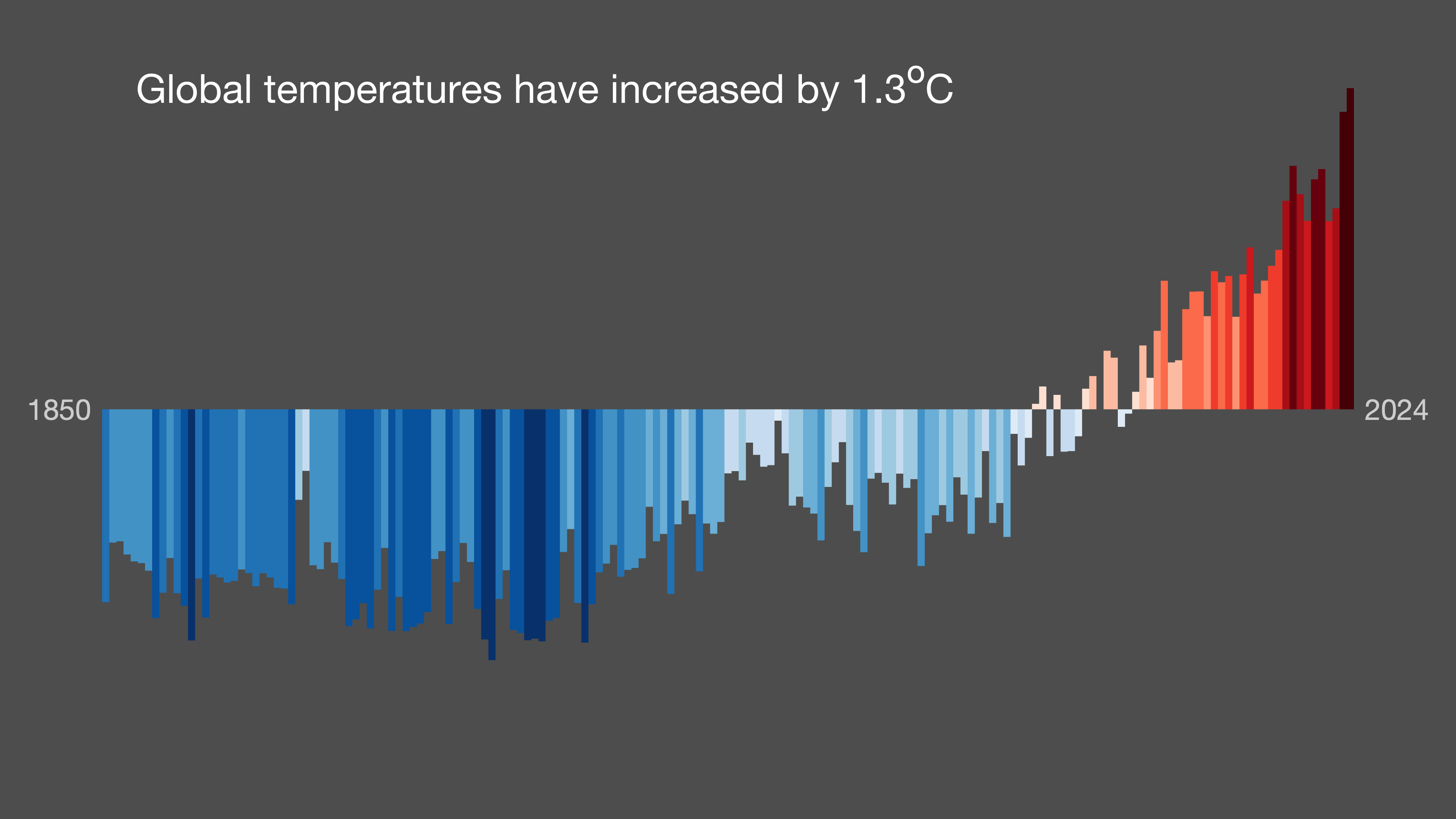
A new study shows with 98% certainty that the rate of global warming is increasing. The 1.5 °C warming threshold could be reached in the coming years, in violation of the Paris Agreement. To prevent global warming of 3 °C, the use of fossil fuels must be phased out immediately.
The research by Grant Foster and Stefan Rahmstorf, published on 5 March in Geophysical Research Letters, 1 shows that the planet is warming faster than ever since temperature observations began 200 years ago. The authors used five independent datasets of global average temperature and removed the signals from natural factors – El Niño variation, volcanic eruptions and variations in solar activity. This revealed the development of warming due to human factors. The message is clear: if warming continues at this rate, the Paris Agreement threshold of 1.5 °C warming since the start of the Industrial Revolution will be reached within a few years.
If warming exceeds 1.5 °C in a single year, this does not mean that the Paris Agreement has been violated. It is about average warming over a long period of 20 years. The acceleration observed in the new study is rapidly bringing that moment closer. Human activities are the main cause of long-term global warming, through greenhouse gas emissions and changes in land use. However, natural factors also have a warming or cooling effect from year to year.
Removing noise
The authors used five different temperature datasets, from NASA, NOAA, the HadCRUT5 dataset from the Met Office Hadley Centre and the University of East Anglia, Berkeley Earth and Copernicus ERA5. 2 From these, they filtered out the natural variability in temperature, which they referred to as “random noise”.
El Niño and La Niña – collectively referred to as the El Niño-Southern Oscillation (ENSO) 3 – are generally the most important factors causing annual fluctuations in global temperatures. The authors of the study identify volcanic activity and changes in solar variation as the two other major natural influences on global temperature trends. They used a statistical method they had developed for a previous study.

Each graph shows the original warming data (light blue), which includes all factors contributing to warming, as well as the corrected data (dark blue), which filters out the effects of ENSO, volcanoes and solar activity.
Acceleration
The aim of this study was to test whether the method used would reveal a statistically significant acceleration in the long-term data. The noise from natural variation makes it difficult to identify such an underlying trend. The results show an acceleration in all five datasets with a 98% confidence level. When the same tests were performed on the uncorrected data, they did not even reach a 95% confidence level.
According to the study, the global temperature rose by an average of about 0.2 °C per decade between 1970 and 2015. However, the research shows that warming began to accelerate to 0.34–0.42 °C per decade sometime between February 2013 and February 2014. It appears that the rate of warming in the past decade was higher than in any other decade in instrumental measurements.
If this rate of warming remains constant, the 1.5 °C threshold set out in the Paris Agreement would be exceeded between 2026 and 2029, the authors conclude. Their approach estimates the 20-year period in which the average warming exceeds 1.5 °C, and the limit is considered to be exceeded at the midpoint of this period.
The table below shows the main results for the five different datasets, including estimates for the date when warming accelerated, the rate of warming, and the year in which the Paris Agreement will be breached in each case.

Discussion
Not everyone is convinced that the data show an acceleration in warming. A recent report, Indicators of Global Climate Change, 4 estimates warming over the period 2015-2024 at 0.27 per decade. Other authors, such as Michael Mann and Zeke Hausfather, are also sceptical about Foster and Rahmstorf’s conclusions. Hausfather explains that the observed acceleration in warming ‘largely corresponds to the expectations of climate model simulations in IPCC scenarios such as SSP2-4.5, in which greenhouse gas emissions continue to rise slightly while sulphur dioxide and other aerosols are rapidly cleared’. 5
On the other hand, an acceleration of warming is supported by other observations, such as data on the amount of heat energy stored in the oceans. This appears to have been increasing at an accelerated rate in recent years. The Earth’s energy imbalance – the difference between incoming solar radiation and outgoing heat radiation – has also increased in recent years.
- Foster, G. and Rahmstorf, S. (2026): Global warming has accelerated significantly. Geophysical Research Letters, doi: 10.1029/2025GL118804.[↩]
- Tandon, A. (2026, March 6). Pace of global warming has nearly doubled since 2015, reveals study. Retrieved 10 March 2026, from Carbon Brief website: https://www.carbonbrief.org/pace-of-global-warming-has-nearly-doubled-since-2015-study-says/[↩]
- See Klimaatwiki El Niño en La Niña.[↩]
- Forster, P., & Rosen, D. (2025, June 18). Guest post: Why 2024’s global temperatures were unprecedented, but not surprising. Retrieved 10 March 2026, from Carbon Brief website: https://www.carbonbrief.org/guest-post-why-2024s-global-temperatures-were-unprecedented-but-not-surprising/[↩]
- https://www.carbonbrief.org/pace-of-global-warming-has-nearly-doubled-since-2015-study-says/[↩]