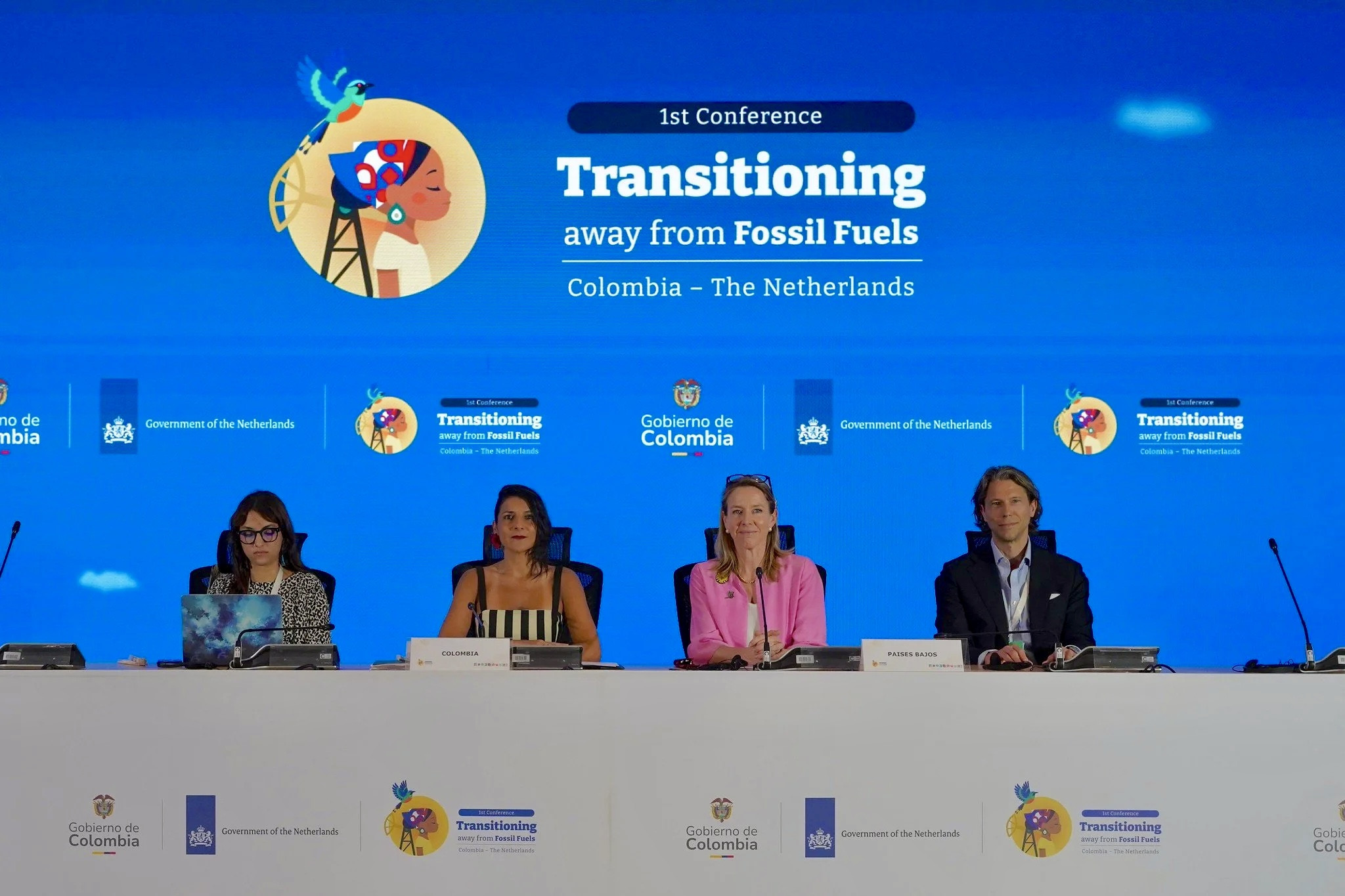
There is some good news: Last month, the First Conference on Transitioning away from Fossil Fuels was held, in Santa Marta, Columbia, from 24 to 29 April. 1 This conference came out of the COP-conferences but is not part of it. Rather, these conferences—plural, because the next one is already planned, for next year 2 —are meant to complement the COP-conferences. They bring together countries that want to actively phase out fossil and move towards renewable energy.
Here’s some context that can help to appreciate what is special about this.
The UNFCCC
Based on the 1992 United Nations Framework Convention on Climate Change, almost all countries in the world come together each year for a COP-meeting, rotating between continents. 3 The Framework Convention is primarily a framework and contains one general objective: ‘stabilization of greenhouse gas concentrations in the atmosphere at a level that would prevent dangerous anthropogenic interference with the climate system’.
If countries want to make more specific treaties, with legally binding duties, they can do that during the COP-meetings. So, at COP-3 (1997), countries made the Kyoto Protocol. 4 It contained specific, legally binding duties to reduce greenhouse gas emissions. It was a relative failure, precisely because key countries did not like these binding duties and did not ratify (US) or withdrew (Canada). 5
At COP-21 (2015), countries made the Paris Agreement. 6 Its key objective is to limit the rise of global average temperature to well below 2 °C and make efforts to limit this to 1.5 °C. This objective struck a balance between the vague objective of the UNFCC and the strict duties of the Kyoto Protocol and is considered a success. Nevertheless, questions about which countries need to take which measures are, of course, heatedly debated and negotiated, both nationally and internationally.
Climate justice
Such questions relate to climate justice. Its basic idea is that countries that have benefited most from using fossil fuels for decennia (the global North, and rich people worldwide), and have thus contributed to climate change, need to make significant efforts to transition from fossil to renewable, whereas countries that have not used, or are currently not using, a lot of fossil fuels, but are suffering most from climate change (the global South, and poor people worldwide), need to receive support and funds to transition from fossil to renewable.
Some of this is captured in the notion of ‘common but differentiated responsibilities and respective capabilities’ (Paris Agreement art. 2.2). Rich countries have larger duties to combat climate change and need to support poor countries in their combatting of climate change.
Phasing-out fossil fuels
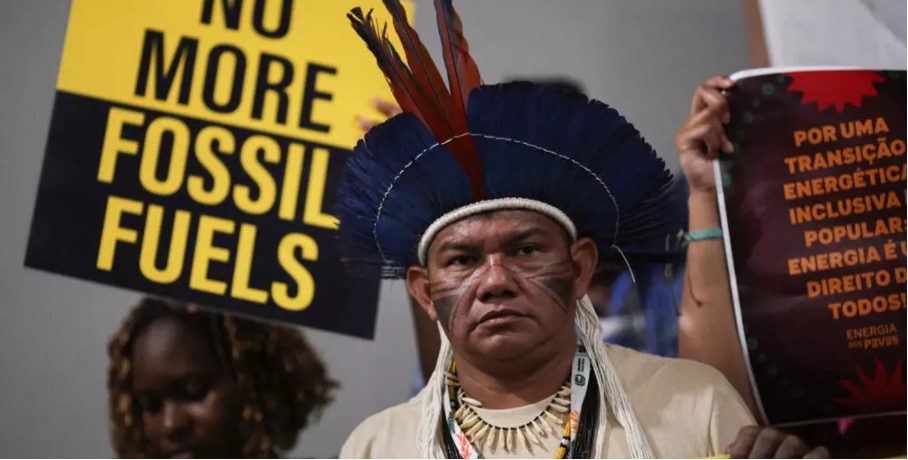
Back to the COP-meetings. COP-meetings work on the basis of unanimity. All countries need to agree. It is therefore easy, e.g., for one or several countries that benefit from extracting and selling fossil fuels, to veto proposals to transition from fossil to renewable. 8 Tellingly, the word ‘fossil’ never appeared in the closing statements of any of the COP-meetings. Until COP-28. 9
The closing statement of COP-28 (2023) contained the following, as global efforts that states need to contribute to: 10
‘Transitioning away from fossil fuels in energy systems, in a just, orderly and equitable manner, accelerating action in this critical decade, so as to achieve net zero by 2050 in keeping with the science’ and
‘Phasing out inefficient fossil fuel subsidies that do not address energy poverty or just transitions, as soon as possible’.
The presidency of COP-30 (Belém, Brazil 2025) had wanted to produce a roadmap to phase out fossil fuels, but, because of this requirement for unanimity, this did not happen. At the close of COP-30, however, the governments of Colombia and the Netherlands announced that they were to co-host a conference to produce such a roadmap. That conference happened last month.
The conference
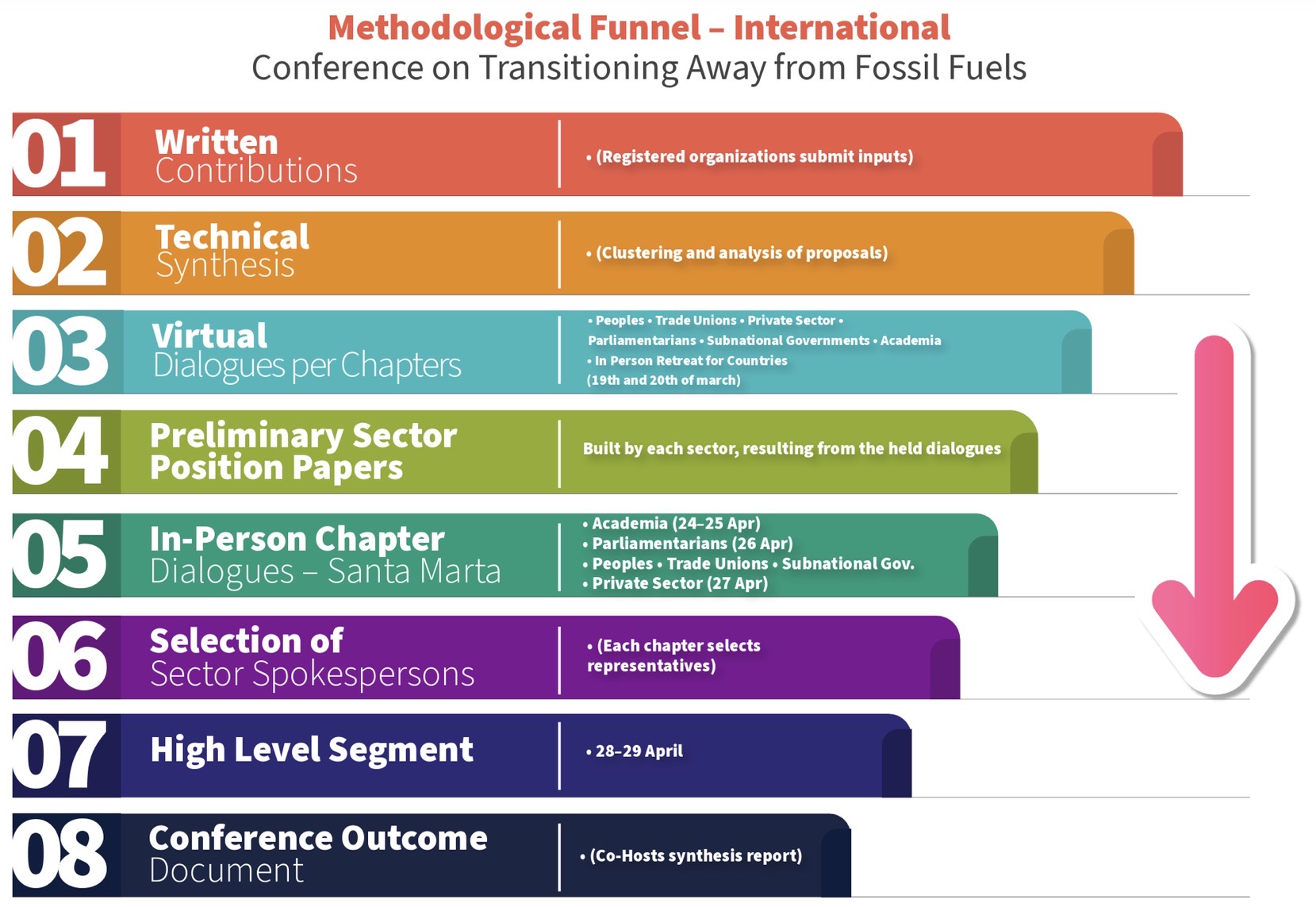
Because this conference was not a COP-meeting, the organisers had relatively more freedom to design a process fit for purpose. They invited different types of stakeholders to provide input: Parliamentarians; Academia; Private sector; Communities, including Indigenous peoples, NGOs, Afro-descendant communities, Smallholder farmers, Women and diverse groups, Youth, Social movements, and Trade unions. 11 During the conference, delegates from 57 countries came together for six days of deliberation and negotiation.
The conference was organised around three themes:
- Reducing economic dependence on fossil fuels, e.g., overcoming systemic lock-ins and entrenched power;
- Transforming supply and demand, e.g., banning new fossil infrastructure and phasing-out fossil subsidies;
- Advancing international cooperation; e.g., with regards to new legal frameworks and sharing knowledge.
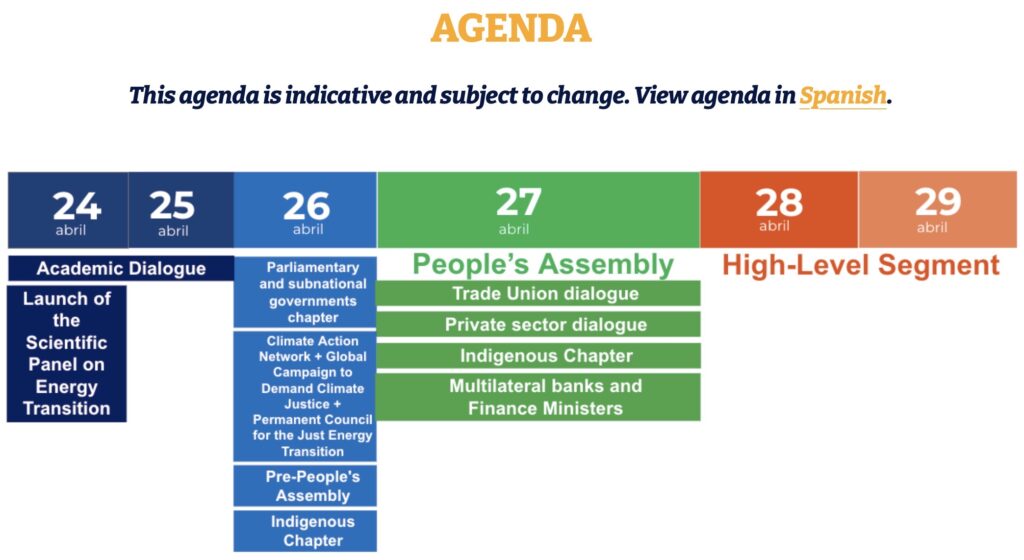
Interestingly, science was the conference’s starting point; a Scientific Panel on Energy Transition was launched on the first day. 13 This was rather refreshing, compared to how negotiations in climate diplomacy typically go, with lots of time spent on politics.
Moreover, the participating countries do want to phase-out fossil fuels and want to base their plans on insights form scientific research. ‘Here, you have a coalition of governments that decided they actually want to be informed by the science,’ says Margaretha Wewerinke-Singh, a well-known expert on climate-change law from the University of Amsterdam. The Scientific Panel produced a set of twelve recommendations for countries to indeed transition from fossil to renewable. 14
Hopefully, this Conference can enable countries to take measures to indeed reduce greenhouse gas emissions and keep our planet liveable.
Further reading:
Conference Report, ‘Co-host takeaways on the First Conference on Transitioning Away From Fossil Fuels’, 30 April 2026
Santa Marta Action Repertoire (SMART) Summary, ‘Insights from the Synthesis Report workstream of the Santa Marta Academic Dialogue’, 27 April 2026
‘Hope is contagious and science is king: 10 big lessons on ending the fossil fuel era’, The Guardian, 1 May 2026, https://www.theguardian.com/environment/2026/may/01/santa-marta-colombia-climate-conference-ending-fossil-fuel-era
- https://transitionawayconference.com/home[↩]
- https://www.government.nl/latest/news/2026/04/29/transitioning-away-from-fossil-fuels-conference-concludes-with-5-key-deliverables[↩]
- https://unfccc.int/process-and-meetings/united-nations-framework-convention-on-climate-change[↩]
- https://en.wikipedia.org/wiki/Kyoto_Protocol[↩]
- https://en.wikipedia.org/wiki/Views_on_the_Kyoto_Protocol[↩]
- https://en.wikipedia.org/wiki/Paris_Agreement[↩]
- https://www.rfi.fr/en/environment/20251122-cop30-climate-summit-runs-into-overtime-amid-divisions-over-fossil-fuels[↩]
- https://www.nature.com/articles/d41586-025-03802-1[↩]
- https://unfccc.int/news/cop28-agreement-signals-beginning-of-the-end-of-the-fossil-fuel-era[↩]
- https://unfccc.int/sites/default/files/resource/cma2023_16a01_adv_.pdf[↩]
- https://transitionawayconference.com/participants; https://transitionawayconference.com/contributions[↩]
- https://transitionawayconference.com/methodoloy[↩]
- https://www.theguardian.com/environment/2026/apr/25/new-global-panel-aims-to-accelerate-move-away-from-fossil-fuels[↩]
- https://www.lasillavacia.com/wp-content/uploads/2026/04/SMART-summary_for_policymakers_final_without-comments-2-1.pdf[↩]