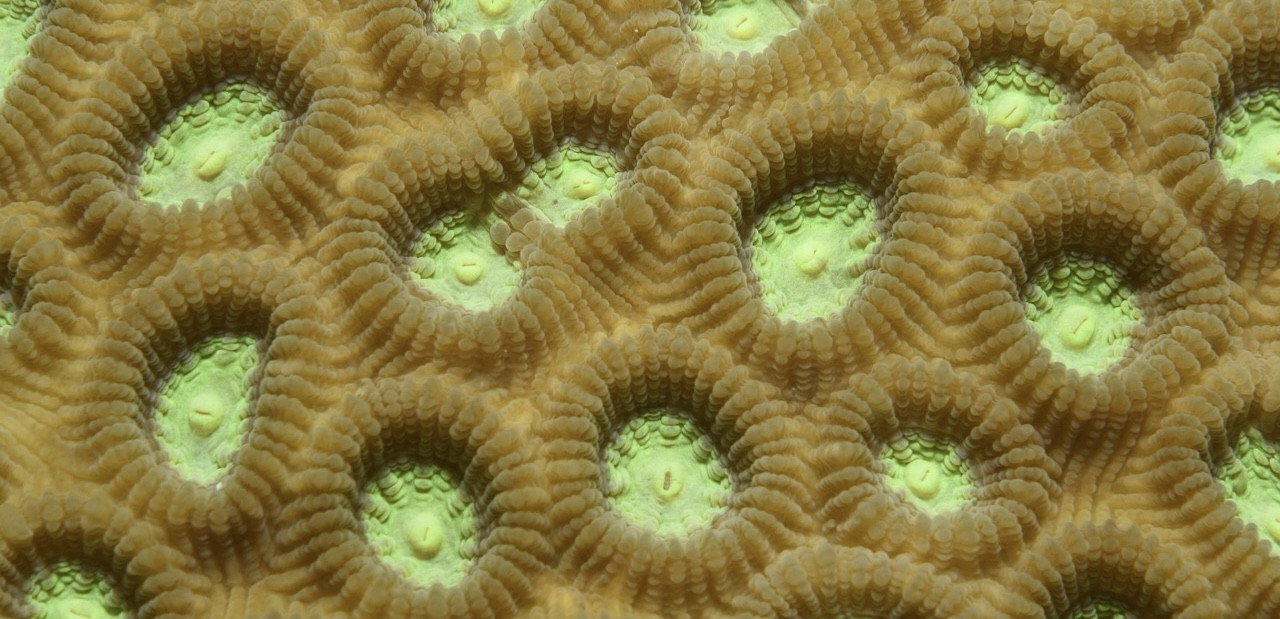
Coral reefs act as climate sensors: since the first bleaching was observed in the 1980s, they have consistently shown the impact of warming and acidification. Overfishing, nutrient pollution and disease have pushed these fragile ecosystems to a critical tipping point, if they have not already passed it. The question is whether recovery is still possible. It is clear that action to limit global warming as quickly as possible is crucial.
Erik Meesters, PhD
I have been studying coral reefs since 1987. Coral reefs play a central role in the climate history of the last 50 years because they were among the first to dramatically indicate that climate change would have a major impact on our world. During an El Niño event in the early 1980s (El Niño is a period in which the sea water warms up more than normal), coral bleaching was observed for the first time. Corals suddenly turned white and died. It became clear that bleaching was caused by rising sea water temperatures. Since that first coral bleaching (see box), bleaching has become increasingly common, now occurring almost annually. Never in the history of the Earth has the temperature risen as rapidly as it has over the last 150 years.
At a tipping point, a system suddenly changes to a different stable state and can no longer be easily restored to its previous state. For example, a reef that consists mainly of coral can turn into a reef covered by algae. Such a state is stable, but it is certainly not a healthy coral reef.
An example of such a tipping point can be found in the coral reefs in the Caribbean, for example on Bonaire and Curaçao. Long before we thought about climate change, coral reefs were heavily fished. There was such an abundance that people thought the supply was unlimited. This led to overfishing. Fish that played an important role on the reef declined sharply or disappeared.
Pollution
In addition, improved healthcare led to rapid population growth and, with it, an increase in the amount of sewage. Most islands do not have good sewage treatment facilities, and during tropical rainstorms, sewage flows unhindered into the sea. The nutrients in the sewage caused a sharp increase in the growth of algae on the reef floor. Fortunately, large numbers of sea urchins kept the algae growth under control. The fish that normally kept the sea urchins under control had disappeared due to overfishing, allowing the sea urchin population to grow unchecked. They became so numerous that you could not set foot on the reef without stepping on a sea urchin.
Until then, corals and algae had been somewhat in balance: the sea urchins ensured that the corals were not overgrown by algae. In the early 1980s, however, a disease caused high mortality among the sea urchins and the system came under severe pressure. The existing corals were suppressed and new corals were unable to establish themselves in areas where algae grew. The coral reef suddenly began to deteriorate rapidly. In addition, since the early 1990s, the effects of climate change have been felt. The rise in sea water temperature is increasing, and so is the stress on corals. As a result, we are seeing more and more so-called ‘bleaching events’, and coral reefs around the world are deteriorating very rapidly.
The decline that I and other coral reef biologists have seen over the last 35 years is so great that I fear coral reefs are in danger of disappearing completely. Then only film footage from the last century will be able to show us what a healthy coral reef looks like. According to some, we have already passed the tipping point for coral reefs. 1
Can we still save coral reefs?
Yes, but it’s not easy and it’s getting harder. To revive an almost dead coral reef, you have to cross the tipping point again. It’s like resuscitation! This is only possible if fossil fuel emissions are reduced as quickly as possible, so that the Earth’s temperature does not rise by more than 1.5 degrees.
In addition, we must minimise all other stress experienced by corals to give them a chance to recover. This means, above all, ensuring that the water quality is good and that no harmful bacteria or excess nutrients enter the sea. The latter can only be achieved if the water from tropical rainstorms is collected and does not flow directly into the sea. As a coral scientist, I would also like someone to make black sea urchin disease resistant. Who knows, we might be able to establish a positive feedback loop and save the coral reef after all.
What is bleaching?
High sea water temperatures cause stress to corals, which affects the symbiotic relationship they maintain with single-celled algae. Corals are part animal, part plant, which makes them such unique organisms. At some point in evolution, algae cells were incorporated into the tissue of the coral animal. Corals are therefore able to use sunlight for their energy supply. This unique characteristic enables them to build coral reefs such as the Great Barrier Reef. Each individual coral forms a skeleton of calcium carbonate under a thin layer of living tissue.
As a result of climate change, seawater is becoming warmer and the relationship between the coral and its symbiont, i.e. between the coral animal and the algae cells, is being disrupted. The coral loses its symbiont. Since it is the algae cells that give the coral its colour, the coral effectively becomes transparent, and beneath that transparent tissue lies the coral’s calcium skeleton, which is white. As a result, a coral reef suddenly looks like a snowy landscape (photo 1).
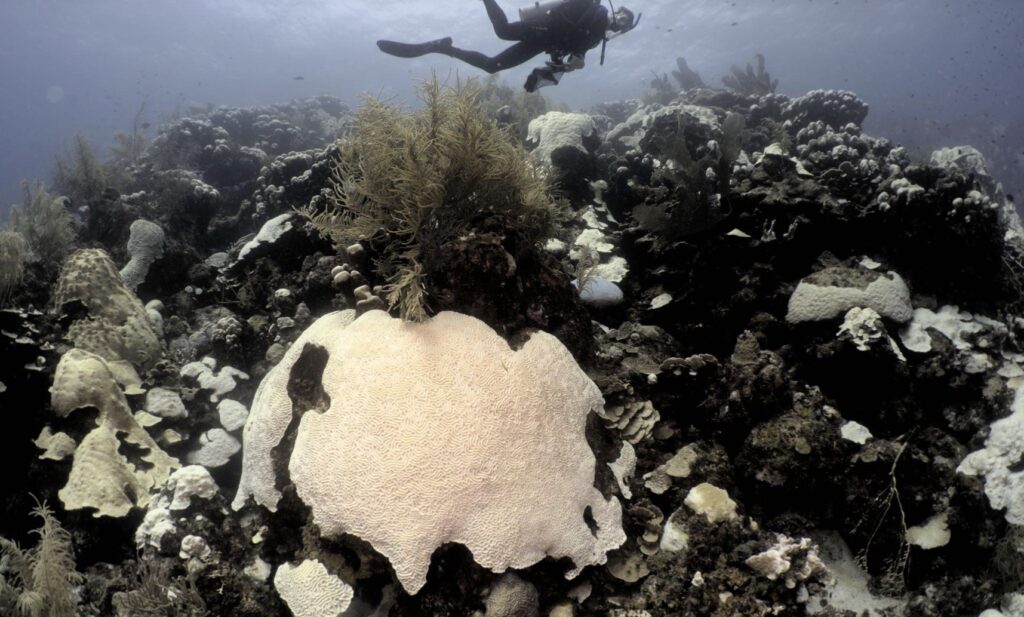
The coral is not yet dead, but since the algae cells that feed the coral are no longer there, the coral starves. Within a few days to weeks, the coral dies. The remaining skeleton is colonised by algae, causing the bright white colour to disappear again. If the high sea water temperature drops in time, the coral can recover and regain its normal colour because the algae return to the coral animal. Often, you can observe all these different phases, bleaching, death and colonisation by algae, on a coral colony (photo 2).

See Why I’m active: Erik Meesters.
- Lenton, T. M., Milkoreit, M., Willcock, S., Abrams, J. F., Armstrong McKay, D. I., Buxton, J. E., Donges, J. F., Loriani, S., Wunderling, N., Alkemade, F., Barrett, M., Constantino, S., Powell, T., Smith, S. R., Boulton, C. A., Pinho, P., Dijkstra, H. A. Pearce-Kelly, P., Roman-Cuesta, R. M., Dennis, D. (eds), 2025, The Global Tipping Points Report 2025. University of Exeter, Exeter, UK. ©The Global Tipping Points Report 2025, University of Exeter, UK.[↩]