
With the holidays just round the corner, the question arises: shall we fly? For most climate activists, it’s a no-brainer, but we do occasionally get asked this by family or friends. Someone might say, for example, that it’s better to fly to Barcelona than to drive there. Here’s what the Klimaatwiki has to say on the subject, on the page ‘Debunking and “pre-bunking” misinformation’ (in Dutch).
For references, see footnotes in the Dutch version of this post.
Is flying to Barcelona better for the climate than travelling by car?

Flying is the most polluting mode of transport. The claim that flying is better than travelling by car usually stems from a comparison of emissions per person on a long journey. A full or fuel-efficient passenger aeroplane may emit less CO₂ per passenger than someone driving alone in an average car over the same route. However, this result does not always hold true – it depends heavily on the distance, the load factor, the vehicle’s fuel efficiency and whether the journey is a short or long flight. [1]
What the science says
Flying is almost always the most polluting form of transport — both in terms of CO₂ emissions and emissions of other harmful substances — with the greatest impact on the climate. Travelling by train is by far the best option for the climate — even better than travelling by car.
Climate myth
It’s better to fly to Barcelona than to drive, as you’ll emit less CO₂. Claims like this are sometimes made in the media.
More facts and explanations
The website Our World in Data [2] provides an overview of carbon emissions per kilometre travelled. This shows that flying and driving are by far the most polluting modes of transport.
Travelling by train is a particularly low-carbon way of travelling. If you take the train instead of the car for medium-distance journeys, this would reduce emissions by around 80 per cent. If you take the train instead of a domestic flight, this would reduce your emissions by around 86 per cent.
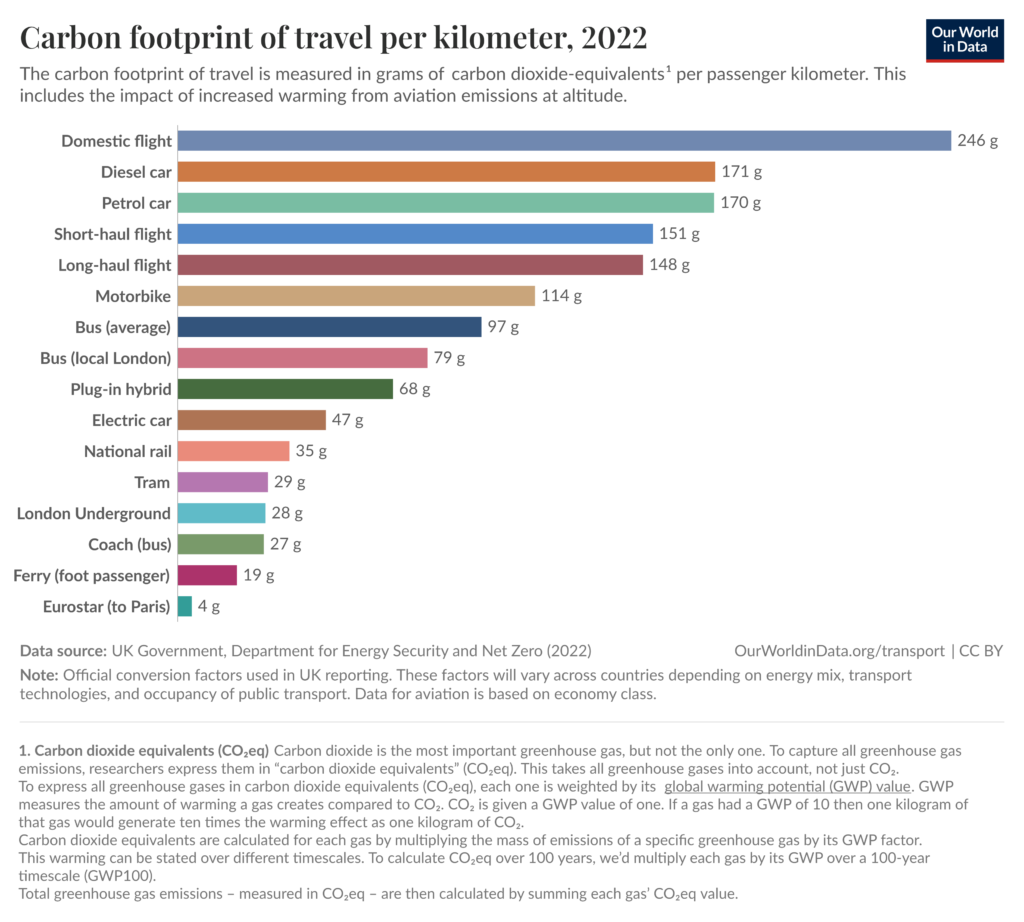
The data is taken from a UK government report. [4] It corresponds well with figures provided by other sources, such as Terrapass, [5] the University of Manchester’s Carbon Savings Tool [6] or the ICAO’s Carbon Emissions Calculator. [7]
Emissions from air travel are often measured per passenger-kilometre, not per aircraft. Because an aeroplane carries many people, the emissions are spread across more passengers, making a flight on some long routes appear more favourable than a solo car journey. One source cites, for example, a return flight from New York to Los Angeles, where emissions per passenger are lower than when travelling alone in an average car. [1]
Where the comparison no longer holds true
For short journeys, driving is often better, especially if there is more than one person in the car. The BBC summary [8] notes that petrol or diesel cars perform better than flying in many cases, and that adding just one extra passenger can tip the balance in favour of driving. Electric cars, trains and buses can alter the comparison even further.
People often hear a simplified version of a more specific statement: “Flying can result in lower emissions than driving alone on some long journeys in a relatively inefficient car.” This is shortened to “flying is better for the climate than driving”, which is misleading because it does not take into account the number of passengers and the length of the journey. A more accurate rule is that travelling alone in a petrol car is sometimes worse, but carpooling or driving efficiently is often better.
Carbon offsetting
Some airlines offer CO₂ offsetting for their flights. You pay an additional fee, which is spent on projects that capture CO₂ emissions, for example by planting trees. Ultimately, this is not a solution to the climate crisis: to tackle that, CO₂ emissions must be reduced — and the measure proven to be most effective is to stop burning fossil fuels. CO₂ offsetting does not reduce CO₂ emissions. Read more about CO₂ offsetting in the Klimaatwiki.
Calculation
To compare flying to Barcelona with travelling by car, we use data from Our World in Data. The distance as the crow flies (by air) is 1,200 km and by road it is 1,500 km.
A single-leg flight produces 1,200 × 151 = 181,200 g = 181 kg of CO₂ per passenger. Travelling alone in a petrol car produces 1,500 × 170 = 255,000 g = 255 kg of CO₂ per passenger. Travelling as a pair in a car produces 127.5 kg of CO₂ per passenger, which is already less harmful than flying. Electric cars, trains and buses produce even lower emissions.
Various emissions calculators produce similar results. [1 9 10] The figures vary — depending on the choice of data sources — but the ratios between the different modes of transport are roughly the same.