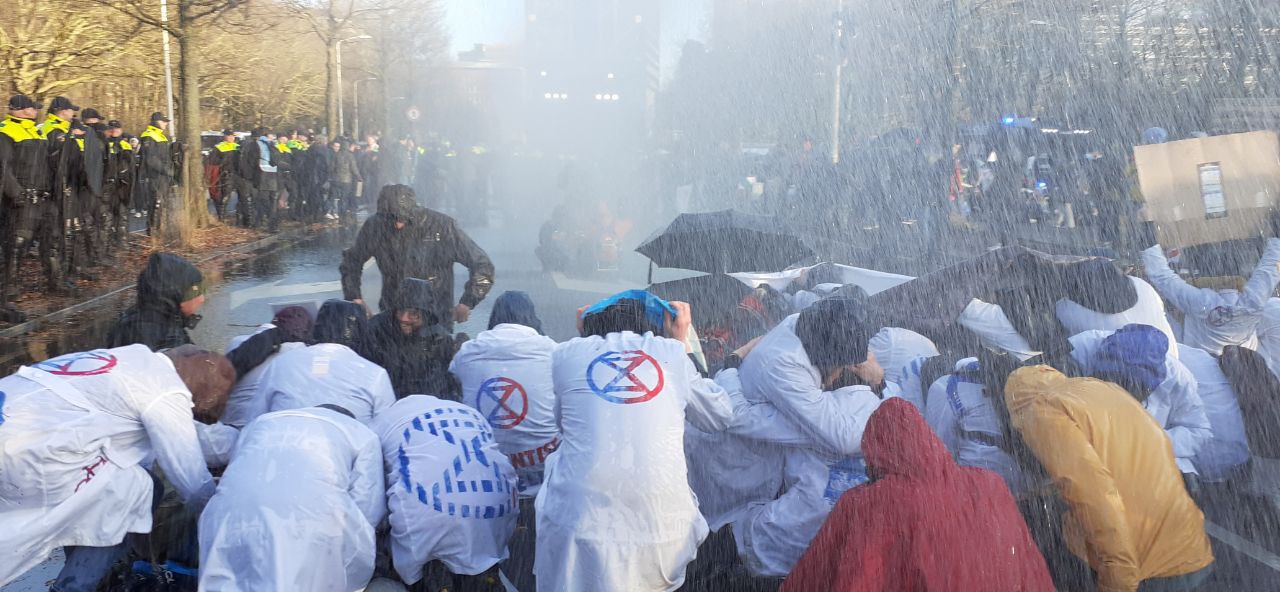
How do we keep up the fight against fossil fuel subsidies? Why do thousands of people in the Netherlands take to the streets time and time again, despite police violence or intimidation by the prosecution? Non-violently, despite the violence they are sometimes confronted with.
Yes, we’re a nuisance, but we’re fighting for a cause that affects everyone: the climate crisis. And history shows that peaceful citizen action ultimately succeeds. We hope we’re still in time to prevent the worst consequences of the climate crisis.
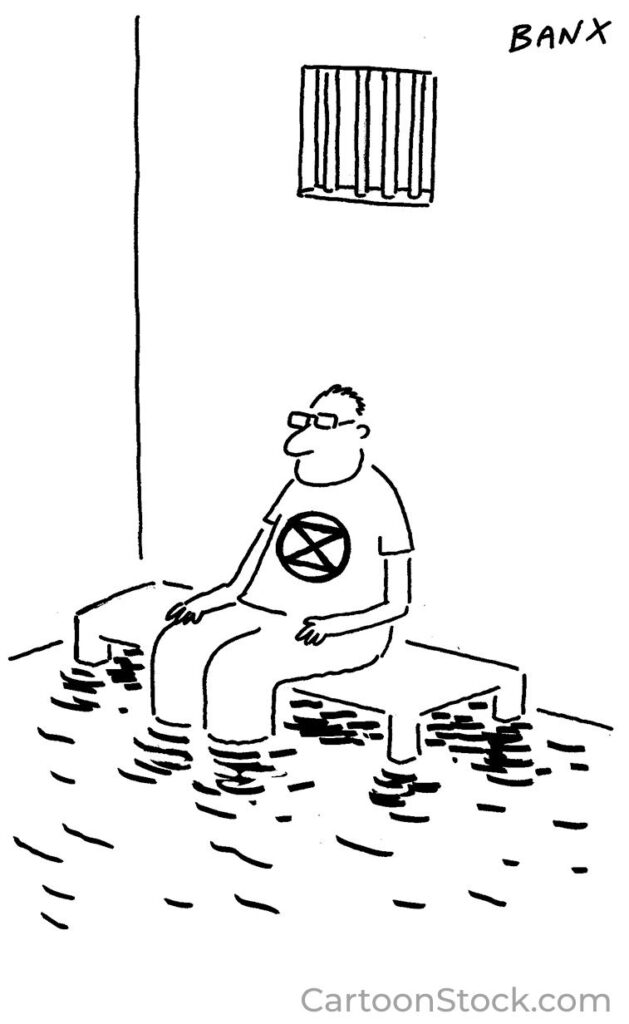
I am one of the 20 people who were held in solitary detention for 30 hours following the protest on the A12 on 4 July. In the cell, there was no toothbrush, no extra blanket and certainly no pen and paper. But there was plenty of time for reflection. I think about what this must be like for my wife, because neither she nor I know how long this will last. I’m thinking about ideas I’m trying to develop for my work. I imagine what I’d like to say to politicians or to the editorial teams of talk shows, if I were given the chance. We’re living in a time that resembles the film ‘Don’t Look Up!’, and politics and the media seem incapable of discussing it seriously.
We were released without our phones.
We support one another
After the protest, we meet up outside the cell block. People are waiting for us there who know what this protest has cost us. We can feel it in our own bodies. We briefly discuss the violence we’ve experienced or witnessed, whether from the police or hostile members of the public. They give us coffee, and we’re allowed to borrow a phone. I ring my wife to tell her I’m free again and will be home this evening. I tell her that I heard people in the cells around me being told they were free to go, but that I didn’t dare feel any relief until I was standing outside myself.
After the protest, we keep in touch. We share our experiences and process them together. We realise that this is a lot harder without a phone, without being able to watch the videos that are often circulated after a protest. There are no videos from our part of the protest, as our phones have still been confiscated. There are, however, videos of angry farmers who nearly run over environmental activists with their tractors.
Back home, we can no longer log into our work systems, nor can we use online banking. More than three weeks later, there’s still no charge and no indication of when we’ll get our phones back. Our lawyer says this is a highly unusual course of events for him.
We will continue
By now, the whole of the Netherlands knows why SR and XR are taking to the streets. It’s about billions of euros in subsidies to the fossil fuel industry. That works out at thousands of euros per Dutch person per year. Money that fuels climate change and benefits a very small number of companies, which are consequently delaying their innovations.
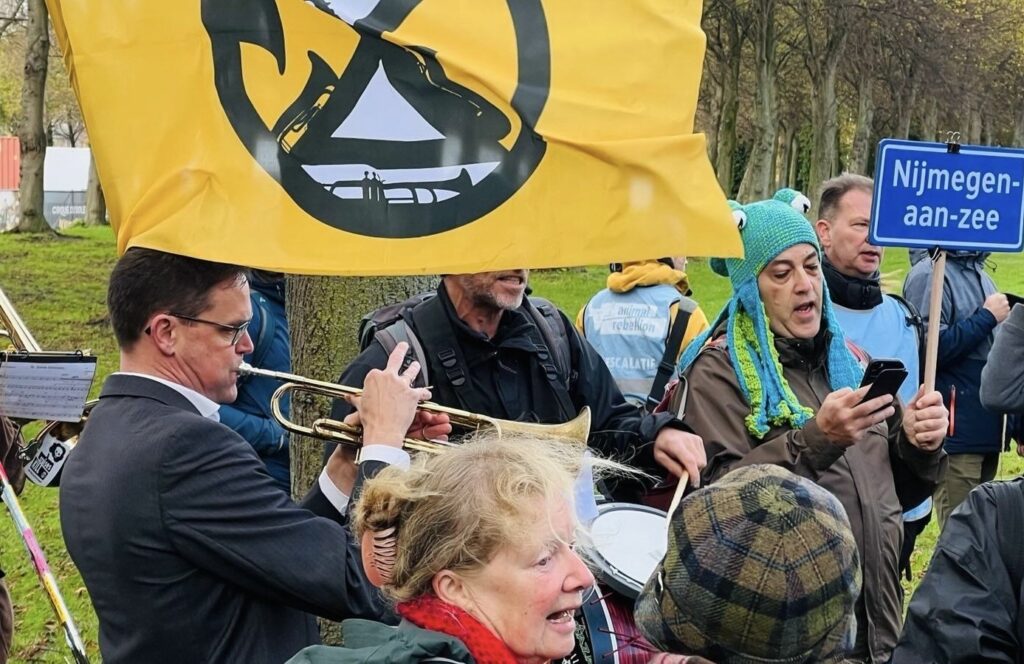
XR has been causing traffic jams in a responsible manner for years. Emergency services are always able to get past without any problems. When we are facilitated by the police – that is, when they do not intervene with the aim of making our demonstration impossible – there is significantly less disruption. This is evident from the data, 1 for example on the occasion when the police themselves exercised their right to strike. Measures taken by the mayor, the police and the judiciary against A12 blockades, on the other hand, often lead to more disruption. 2
There are traffic jams every day: because the roads are busy, because of an accident, because of a large concert at the Malieveld, because a military exercise causes a forest fire, because the tarmac has melted, or because a bridge can no longer close due to the heat. And indeed, once every two or three months there is a traffic jam on the A12 near The Hague or Utrecht because people are sitting on the road, or trying to get onto the road, to bring a major issue back into the media spotlight.
Sometimes we get negative press, but increasingly journalists are showing sympathy for our actions and, fortunately, they do not forget to mention what we are demonstrating for. Yet it continues to amaze me that the media seem unable to raise the issue of the stupidity of fossil fuel subsidies of their own accord. Why don’t journalists ask politicians questions about this? The media are happy to make news out of other topics.
We know that our way of protesting is a fundamental right, and we want to exercise that right for as long as we still can. This fundamental right is laid down in the European Convention on Human Rights. Instead of working to abolish fossil fuel subsidies – which would free up a huge amount of policy space – politicians are calling these fundamental rights into question.
Once the dust has settled, new A12 blockades are announced on the XR website. How do we find the strength to take part again? How do we muster the courage to join in once more, whilst feeling in our bones just how nerve-wracking it is? We don’t know whether the police will beat us up this time, but we do know that they’ll be there quickly – or might even already be there – when we set off. And yet we go. Time and time again.
How do we keep going? It’s nice, on the way to a protest, to be with people you know are fighting for the same cause as you. People who are determined but whom you also know will remain non-violent. None of the wonderful people in the blockade will physically attack the police. We’ve practised non-violence. If someone gets so angry at a police officer that they’re on the verge of shouting abuse, a fellow XR activist immediately speaks to them about it. That brings a sense of calm at such a tense moment.

What’s the outcome?
Thanks to previous XR actions on the A12 in The Hague, and the efforts of Rob Jetten’s ministry at the time, we now know that fossil fuel subsidies involve staggering sums of money. Estimates range from 39.7 to 46.4 billion euros. 3 Thanks to the actions on the A12 near Utrecht, fossil fuel subsidies are receiving media attention, at least for a few hours. We’ve noticed that, over the past year, news sites have become increasingly consistent in reporting the purpose of an action. Previously, they mainly echoed the police in The Hague; fortunately, the media are now reporting more and more often what the actions are actually targeting.
We certainly see a glimmer of hope in the fact that people are increasingly being told in digital media that this is due to climate change: that unprecedented wildfires are spreading northwards, that river levels in the Netherlands are at historic lows, and that the coral in Bonaire has almost disappeared. Sometimes, such reports now include a statement that we must stop emitting CO₂. Hopefully, in a few years’ time, every such report will include a call for us to end fossil fuel subsidies.
And then what? We hope that, thanks to the ongoing campaigns by XR, SR and Fossielvrij, and through growing awareness, more Dutch people will take action. With every tonne of CO₂ emitted, the problems increase for everyone, but especially for the most vulnerable people. It is foolish to continue providing subsidies to companies that should be working on sustainable alternatives rather than extracting even more oil and gas from the ground.
Tjerk Oosterkamp is a professor of physics in Leiden
- This website, https://www.via.nl/nl-NL/ (subscription required), provides an overview of the traffic situation on various dates. The editorial team has access to specific data.[↩]
- Eyewitness account by police officer Amir Niknam https://www.linkedin.com/posts/amirniknam_demonstratierecht-klimaatcrisis-activity-7284830398990221313-u-to[↩]
- https://nos.nl/artikel/2490599-fossiele-sector-krijgt-tussen-39-7-en-46-4-miljard-euro-subsidie-nog-meer-dan-gedacht[↩]