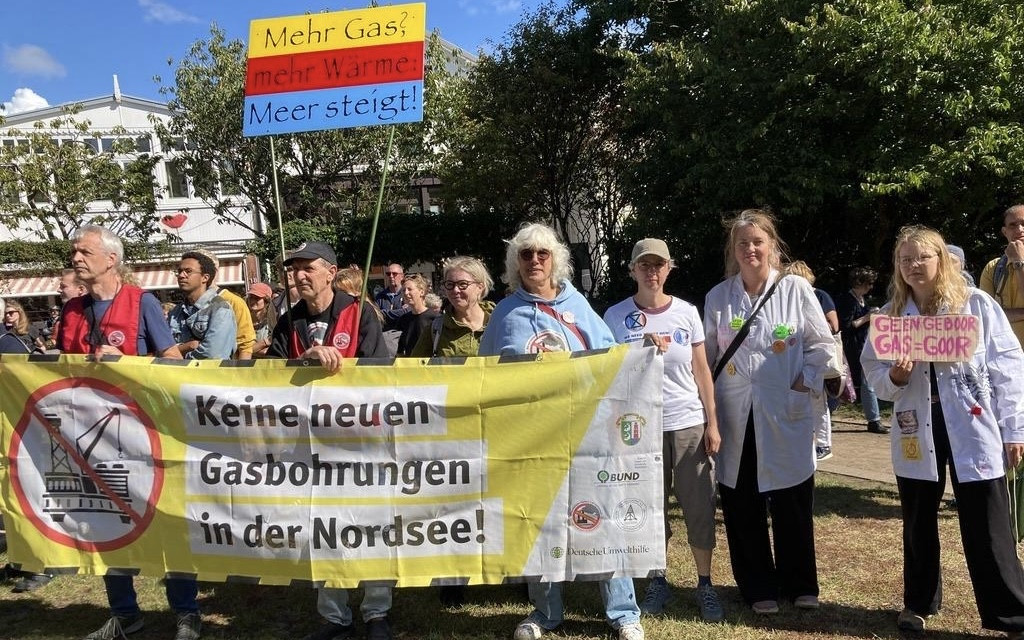
We are facing surging oil prices and rising costs for fertilisers, food and other commodities. Trump’s reckless actions in Iran are pushing the global economy to the brink of an economic crisis. Many are seizing the opportunity to start drilling for oil and gas in the North Sea. This Carbon Brief paper debunks the myths surrounding drilling in the North Sea.
This paper appeared first in Carbon Brief on 25 March 2026 and was written by Daisy Dunne, Josh Gabbatiss, Molly Lempriere and Simon Evans. This text has been republished here under a CC license. We publish it in five parts. Read part 1 here. (Note: Most of these fact-checks also apply to other countries around the North Sea, such as Germany and the Netherlands.)
FALSE: Ed Miliband is an ‘anti-North Sea’ climate change ‘fanatic’
A huge amount of the criticism of the UK government’s position on North Sea oil and gas has been personally levelled at one man: Ed Miliband.
The energy secretary has been repeatedly labelled by opposition politicians and their media allies as “dangerous” and a “fanatic” with a “cult-like conviction”, because of his reported opposition to more drilling in the North Sea.
Miliband’s Conservative counterpart, Claire Coutinho, wrote in the Daily Telegraph:
“As the world gets more dangerous, [Miliband’s] anti-North Sea fanaticism is making Britain weaker and poorer.”
As with much of the criticism aimed at Miliband in right-leaning media, these attacks are often highly personal. The Sun’s US editor-at-large, Harry Cole, referred to Miliband as a “Greta [Thunberg]-loving Marxist, who has never seen a market he doesn’t want to destroy”.
In fact, Miliband is simply the energy minister in a government that has explicitly prioritised climate policies and transitioning away from fossil fuels.
Labour’s 2024 manifesto for the general election in which the party won an overwhelming victory and, hence, mandate stated:
“We will not issue new licences to explore new [North Sea] fields because they will not take a penny off bills, cannot make us energy secure and will only accelerate the worsening climate crisis.”
While the government has repeatedly ruled out new licences, it is considering approving several new projects at sites that have already received licences, but not consent to begin development.
It has also announced new “transitional energy certificates”, which will allow new oil and gas production at or near existing sites.
As for Miliband, his views are far more moderate than the “fanatical” ones portrayed by his detractors.
The energy secretary has been clear that he expects the UK to continue producing oil and gas even as it transitions to net-zero, writing in a recent Observer article:
“As we build our clean-energy future, North Sea production continues to play an important and valuable role, which is why we are keeping existing oil and gasfields open for their lifetime.”
Arguing against more expansion, Miliband noted that the North Sea is a “maturing basin” and that “new exploration licences are simply too marginal to have a meaningful impact on levels of oil and gas production”.
FALSE: ‘We share the same basin with Norway…there is not a geological difference.”
Another frequently repeated false claim in recent debates is that the UK could be more like Norway, where gas output is still close to record output.
For example, Conservative shadow energy secretary Claire Coutinho told parliament on 24 March that there was a “political line drawn down the middle” of the North Sea. She said:
“[W]e share the same basin with Norway…There is not a geological difference; it is a political line drawn down the middle.”
The idea that UK fossil-fuel production is only lower than Norway’s because of “politics” and that there are no geological differences between the two countries is false.
Moreover, the most relevant policy differences between the UK and Norway are not those in effect today, but those that were put in place decades earlier.
Specifically, the UK has already used up the large majority of its North Sea resources, having extracted around 90% of the oil and gas that was available.
In contrast, Norway has only used up 57% of the “expected recoverable resource” from its part of the North Sea, according to official estimatespublished by Norwegian Petroleum.
This is the result of deliberate choices taken decades ago in the two countries, says Prof Caroline Kuzemko, co-director of the UK Energy Research Centre (UKERC) and professor of political economy at the University of Warwick. She tells Carbon Brief:
“The Norwegian government took a strategic decision to have a steady rate of depletion, so the assets didn’t run out too quickly.”
This choice, as well as the state control that Norway has maintained over its oil and gas industry, is “pretty much diametrically opposite” to what the UK has done, she says:
“The Conservatives took a decision [in the 1980s] to allow others to be in control of [the UK’s] North Sea assets and, therefore, we are now in a position where you can’t order anyone to get more oil out, whereas Norway did the opposite.”
Prof Kuzemko notes the then-Conservative government privatised the oil and gas industry in the 1980s, after which there was a “rapid” depletion of the UK’s resources. She explains:
“The rate of depletion of the UK continental shelf has just been rapid, because that’s in the interests of the [private] companies that were running those sites.”
(The revenue from North Sea privatisation and the subsequent rapid extraction of its oil and gas resources was a major – and underappreciated– reason why then-chancellor Nigel Lawson was able to cut income taxes in the 1980s, Kuzemko notes.)
Similarly, former government energy official Dan Quiggin, now a senior policy adviser at NGO Transport and Environment, tells Carbon Brief that Norway simply has more oil and gas left than the UK, where “most of what was there has been extracted”. He says:
“The UK spent its windfall on current expenditure in the 1980s and 1990s. You can’t retroactively have Norway-scale reserves or Norway-scale savings – those decisions were made long ago.”
Quiggin says that there is a “genuine contemporary policy difference” when it comes to the exploration and investment climate for the North Sea. However, he says:
“Norway offers more fiscal stability and actively supports new development, while UK policy has been more volatile. But even if the UK adopted Norway-style fiscal terms tomorrow, there isn’t the underlying resource base to replicate Norwegian production levels. You’d get somewhat more investment in a declining basin, not a Norwegian-scale industry.”