We are facing surging oil prices and rising costs for fertilisers, food and other commodities. Trump’s reckless actions in Iran are pushing the global economy to the brink of an economic crisis. Many are seizing the opportunity to start drilling for oil and gas in the North Sea. This Carbon Brief paper debunks the myths surrounding drilling in the North Sea.
This paper appeared first in Carbon Brief on 25 March 2026 and was written by Daisy Dunne, Josh Gabbatiss, Molly Lempriere and Simon Evans. This text has been republished here under a CC license. We will publish it in five parts. Read part 1 here. (Note: Most of these fact-checks also apply to other countries around the North Sea, such as Germany and the Netherlands.)
MISLEADING: ‘The head honchos of the green lobby say we should drill’
Numerous media outlets have picked up on supportive comments from what the Daily Telegraph has called “net zero’s champions”, backing the use of North Sea oil and gas. Writing in the Daily Telegraph, shadow energy secretary Claire Coutinho said:
“From the wind lobbyists at RenewableUK to the chair of Great British Energy (Miliband’s ‘clean energy’ propaganda outfit), the head honchos of the green lobby say we should drill.”
This point was similarly made in an editorial in the Sun, which stated that “Octopus energy chief Greg Jackson…and even the head of RenewableUK have called for North Sea reserves to be reopened urgently”. These comments were in reference to a handful of specific interventions that, in reality, were far more nuanced than simply calling for more drilling. Indeed, some of the so-called “net-zero champions” have clarified that they are not calling for new licenses at all.
In the Daily Telegraph, Tara Singh, chief executive of RenewableUK, wrote that “it is entirely sensible to support continued domestic oil and gas production in the North Sea”. Similarly, Jackson wrote in the Daily Telegraph that “we should use what’s available from the North Sea”.
The Daily Telegraph published news stories to accompany both of these articles with the headlines “wind industry chief urges Miliband to restart North Sea drilling” and “Miliband must reopen the North Sea, Octopus boss says”.
On LinkedIn, Juergen Maier, chair of the government’s publicly owned, clean-energy company Great British Energy, set out several arguments in favour of more North Sea production. These included slowing job losses in the region, the lower carbon intensity of North Sea oil and gas compared with imports and extra production supporting tax revenues. His comments were picked up by the Financial Times and the Daily Telegraph, with the latter saying the comments from “Miliband’s clean-energy tsar” will “raise eyebrows”.
However, neither Singh, Jackson nor Maier called for new oil and gas licences – and they stressed that North Sea oil and gas will not bring down energy bills. In fact, their position is similar to that of the UK government, which sees domestic fossil fuels playing an “important and valuable role” into the future.
Singh wrote: “Being serious about the UK’s important role in gas also means being honest about its limitations. The North Sea is a mature basin, not a limitless national asset.” She added that politicians should not imply that more domestic drilling would bring down energy bills, as “it will not”. Instead, she wrote that new renewable generation offers “better value” for consumers, both when gas prices are normal and at “crisis levels”. (See: FALSE: “Reopening the North Sea would lower bills.”)
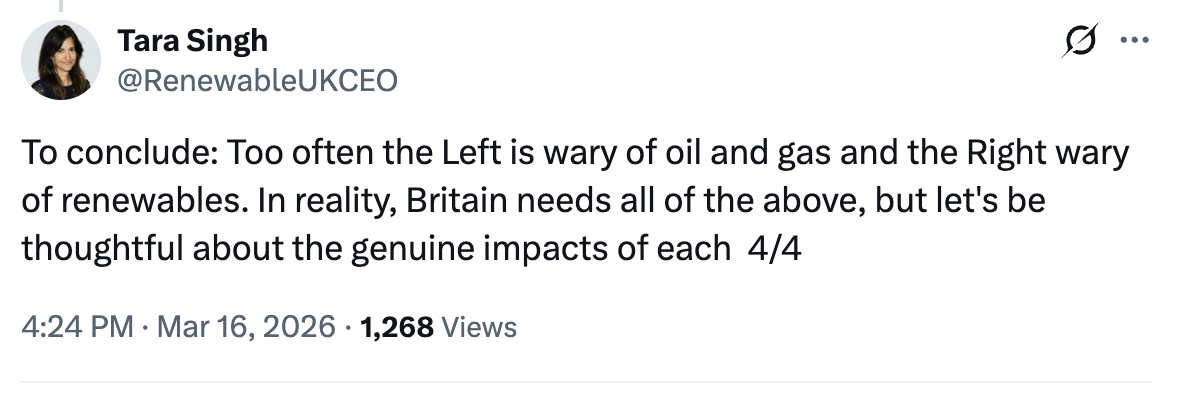
Expanding on her piece on Twitter, Singh clarified “we don’t represent the [oil and gas] sector and we’re not arguing for or against new licences”, adding:
“Before anyone gets too excited: I’m calling for a depoliticised conversation about energy in the UK – not an overhaul of policy to favour oil and gas.”
In his comment for the Daily Telegraph, Jackson added:
“We’re kidding ourselves if we think this is a panacea – it’s 20 years since the North Sea could meet all our needs – we’ve depleted the most abundant reserves and the remainder will be less productive and more expensive. But it makes sense to use what we have whilst we’re so dependent on gas.”
His article, titled “My plan to safeguard Britain’s energy supplies”, only briefly mentioned the North Sea and stressed the importance of “reduc[ing] our dependency on gas”. He continued to set out other potential steps for increasing energy security and bringing down bills, including building nuclear efficiently, cutting energy waste, reforming the electricity market, rolling out domestic renewable generation and breaking the link between gas and electricitythat “lets global chaos dictate our prices”.
In a follow-up interview with Jackson in the Independent, which emphasised these alternatives, he added that the UK was “deluding” itself if it thinks it can “get enough out of the North Sea and in a market where the price is set internationally”.
For his part, Maier clarified on LinkedIn that he was a supporter of a “ managed energy transition” making use of all available energy sources, but adding that this includes “the end game being mostly renewable energy generation”. He also explicitly rejected the notion that more North Sea oil and gas would bring down bills, noting: “It doesn’t; indeed, energy costs are rising at this very moment because of fossil fuels.” Again, this mirrors the view expressed by government ministers.
Maier also subsequently pushed back against the media coverage of his original comments, writing in a follow-up post on LinkedIn that the claim he was pressuring Miliband over North Sea drilling was “wrong” and that he is “fully supportive of the government position”. He added:
“I see this as consistent with an ‘all energy’ approach to the transition. That the end game is renewables and that we need to give supply chain companies enough time to transition. I have said this numerous times in many speeches and posts here.”
FALSE: ‘The UK is the only country in the world banning new oil and gas licenses’
On LinkedIn, Conservative politician and shadow energy secretary Claire Coutinho claimed that the “UK is the only country in the world banning new oil and gas licenses”.
Her comment was made in response to a post about Denmark, which, in 2020, made a landmark decision to stop issuing new oil and gas licences and end all fossil-fuel extraction by 2050.
The post noted that Denmark is now considering “extending one or more production licenses” in the Danish North Sea, in response to the energy crisis.
However, as Coutinho surely knows, this is not the same as issuing new licences – and is more comparable to Labour’s move to allow some additional “tieback” drilling at existing fields, announced in 2025.
Denmark and the UK are not the only countries to end new oil and gas licences. Other nations to do so include Ireland, France, Portugal and Colombia.
In fact, there is an international coalition of nations that have pledged to end new oil and gas production, known as the Beyond Oil and Gas Alliance(BOGA).
This group is helping to convene the first meeting of nations that want to take immediate action to phase out fossil fuels, which is taking place in Santa Marta, Colombia, in April. Around 40-80 nations are expected to attend.
Carbon Brief understands that the UK will have a senior representative at the conference.
Despite showing its support for BOGA, the UK is currently not a member. A senior official once told Carbon Brief that this is because the UK does not currently meet the required end date for stopping all fossil-fuel production.