We are facing surging oil prices and rising costs for fertilisers, food and other commodities. Trump’s reckless actions in Iran are pushing the global economy to the brink of an economic crisis. Many are seizing the opportunity to start drilling for oil and gas in the North Sea. This Carbon Brief paper debunks the myths surrounding drilling in the North Sea.
This paper appeared first in Carbon Brief on 25 March 2026 and was written by Daisy Dunne, Josh Gabbatiss, Molly Lempriere and Simon Evans. This text has been republished here under a CC license. We will publish it in five parts. Read part 1 here. (Note: Most of these fact-checks also apply to other countries around the North Sea, such as Germany and the Netherlands.)
FALSE: ‘Britain is a resource-rich nation that has chosen dependency’
One frequent false claim is that the UK has “chosen” to become reliant on fossil-fuel imports, as a result of policy decisions made by successive governments.
In fact, import dependency has primarily increased because most of the oil and gas in the North Sea has already been used up. It is a “mature basin” with falling output.
In the Daily Telegraph for example, Diana Furchtgott-Roth, former climate director at the Heritage Foundation, a US-based climate-sceptic lobby group, stated that the UK has “chosen dependency”. She wrote:
“[The UK] is not a resource-poor nation forced to depend on foreign suppliers. It is a resource-rich nation that has chosen dependency through planning rules, regulatory obstruction and a net-zero framework that treats domestic oil and gas production as a moral failing rather than a strategic necessity.”
It is true that the UK has become increasingly reliant on fossil-fuel imports. The country was a net energy exporter in 2000, but, by 2010, was dependent on imports for 30% of its energy supplies. On the same metric, the UK’s net import dependency reached 44% in 2024.
This is largely because UK fossil-fuel production peaked decades ago. Gas production in the North Sea fell by 74% between 2000 and 2025, while oil output fell by 75%.
Gas production is set to fall to 99% below 2025 levels by 2050 and oil is set to fall 94%, according to the government’s North Sea Transition Authority(NSTA). Even with further drilling, the NSTA expects gas output to fall by 97% and oil by 91%, as shown below.
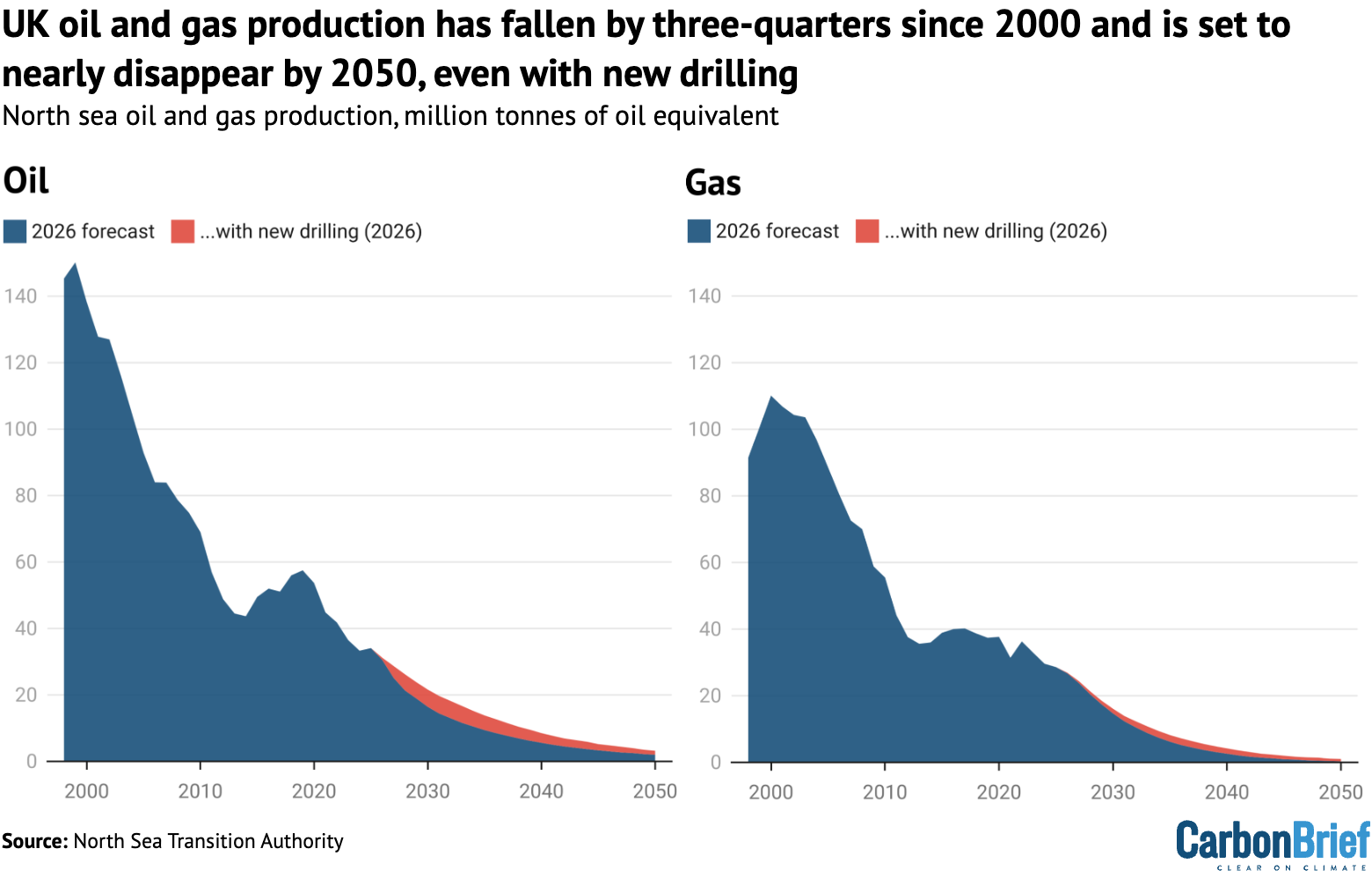
Production has been in an inexorable decline for decades despite strongly supportive government policy through most of the period, including tax breaks and new licensing.
Contrary to the narrative that rising import dependency has been a policy choice, the main reason why production is falling is that the North Sea is a “mature basin”. In other words, most of the oil and gas it once contained has already been extracted and burned.
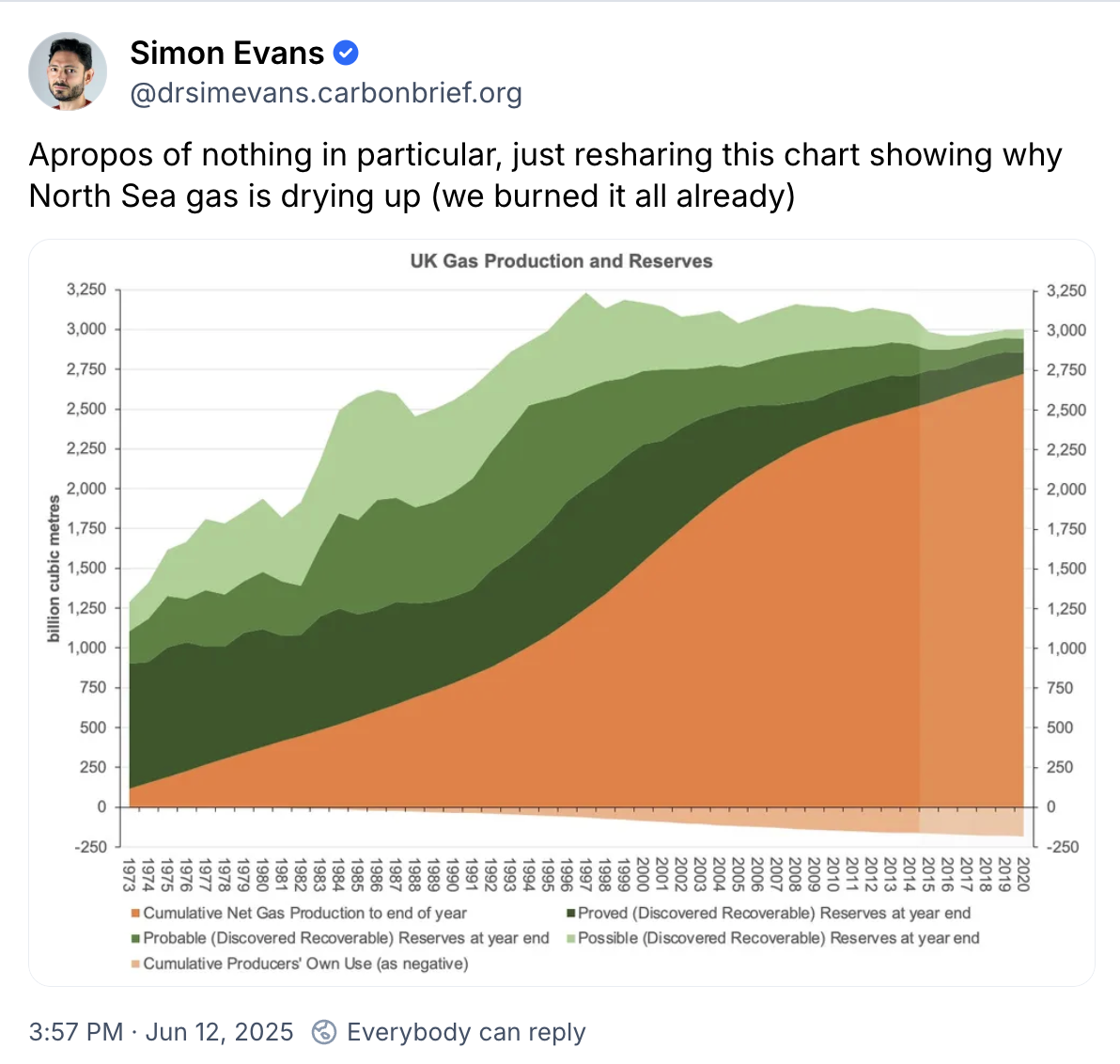
According to the thinktank Energy and Climate Intelligence Unit (ECIU), around 90% of the oil and gas that is likely to be produced from the North Sea has already been burned.
A related argument, aired on Sky News in mid-March 2026, is that the NSTA projections have been revised downwards over time, as a result of government policy. The idea is that there is more oil and gas available, but the government has “chosen” to ignore it.
Yet for gas, there is little difference between the NSTA projections published before and after the government’s 2024 election win and its decision to ban new licensing, as shown below.
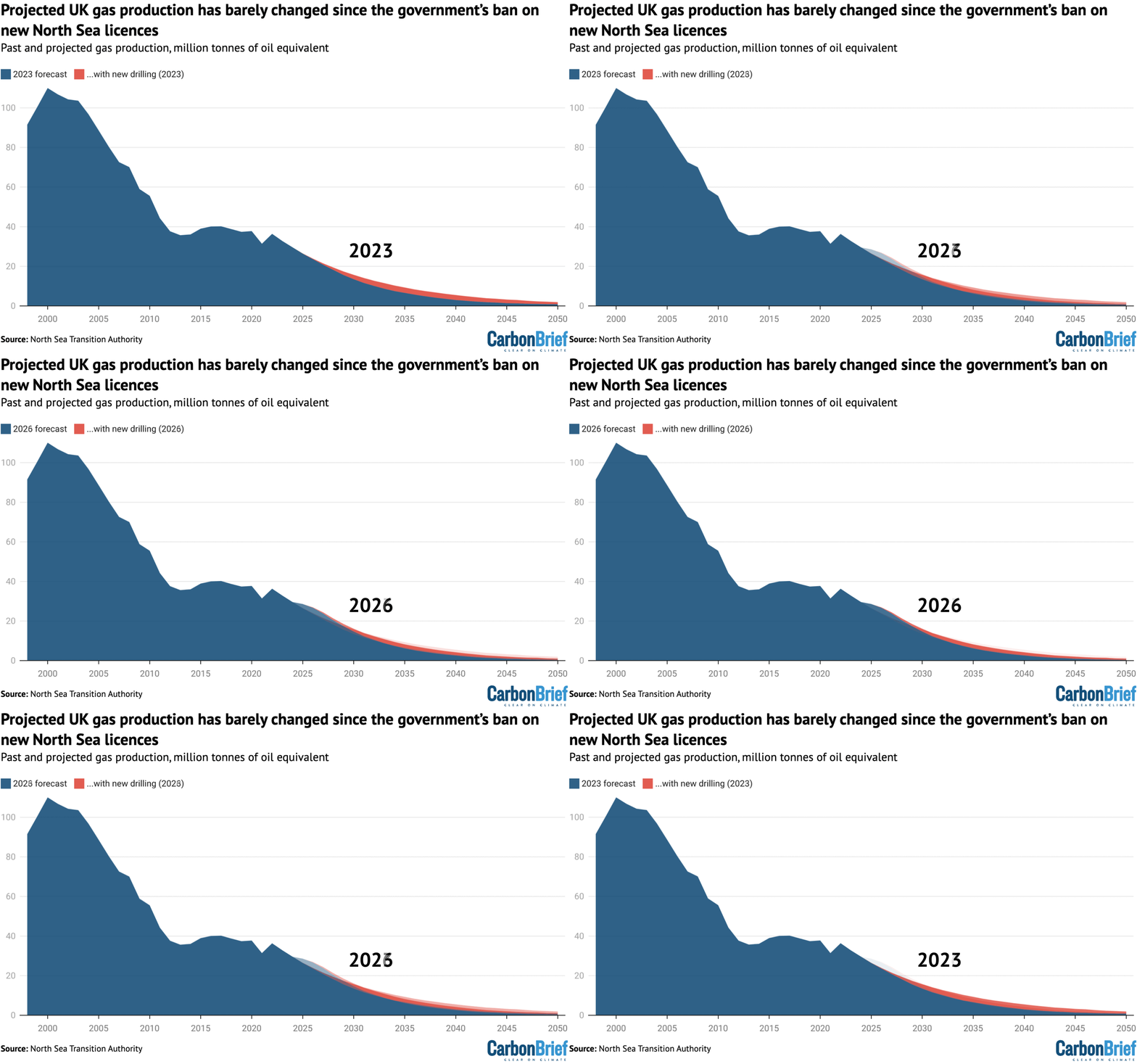
While the NSTA projections for oil have shifted more noticeably between 2023 and 2026, this largely relates to output from existing fields, rather than the potential from new drilling.
There are a variety of other reasons why the NSTA projections have changed, notably including the economic viability of North Sea production.
Until the recent Iran war, UK oil prices had been declining steadily since the highs seen in the wake of Russia’s invasion of Ukraine in 2022.
This will have eroded the economics of North Sea production, particularly as the cost of extraction has gone up by roughly 40% since 2019.
A final claim relating to government policy choices is that the UK has, in the words of a recent Sun editorial, become “heavily dependent on imported energy because of unreliable wind and solar, and the government’s obsession with net-zero”.
This makes no sense – it is the opposite of the truth. Wind and solargenerated more than 100 terawatt hours (TWh) of electricity in the UK last year, meeting a third of total demand.
Carbon Brief analysis shows that generating the same electricity from gas would have required around 200TWh of fuel, equivalent to three-quartersof UK imports of liquified natural gas (LNG).
In other words, without its fleet of what the Sun calls “unreliable wind and solar”, the UK would have needed to nearly double its LNG imports.
FALSE: North Sea is ‘best way to protect us from volatility and provide energy security’
The effective closure of the Strait of Hormuz has triggered the worst energy crisis since the 1970s and has reignited debate over how best to ensure the UK’s energy security.
Many politicians, newspaper editorials and comment articles have argued that getting more oil and gas out from under the North Sea would cut UK fossil-fuel imports and boost energy security.
Some have gone so far as to argue that the North Sea is the “best way” or “the” answer to ensuring UK energy security. This is clearly false. So too is the idea – promoted by the hard-right, climate-sceptic Reform party – that the UK could become “energy independent” by expanding North Sea production.
For example, Conservative leader Kemi Badenoch wrote a comment piece for the Sunday Telegraph under the headline: “Drilling the North Sea is the answer to the energy crisis.”
Meanwhile, Enrique Cornejo, energy policy director at North Sea industry trade association Offshore Energies UK (OEUK), told the Times:
“Current events demonstrate that the best way to protect us from volatility and provide energy security is to maximise our homegrown energy resources.”
The potential for extra oil and gas output is disputed, but not even the North Sea oil and gas industry claims that it could reverse the decades-long decline in production.
Analysis by the National Energy System Operator (NESO) shows that the transition to clean energy would boost UK energy security by significantly reducing fossil-fuel imports. In contrast, it says that imports would rise if the UK boosts domestic oil and gas production but fails to decarbonise.
The UK has been increasingly reliant on energy imports since 2003. This is because UK oil and gas production from the North Sea has fallen by roughly three-quarters since 2000. (See: FALSE: “Britain is a resource-rich nation that has chosen dependency.”)
The UK’s reliance on fossil-fuel imports is set to increase even further, as North Sea production continues to decline. The NSTA says oil output will fall to 94% below 2025 levels by 2050 – or 91% with new drilling. For gas, the figures are 99% and 97%, respectively.
OEUK and other advocates for the oil and gas sector dispute these figures, claiming that higher production would be possible if there are changes in government policy.
For example, a report commissioned by OEUK put forward a “high case” for North Sea production over the coming decades, predicated on what it calls “significant changes to tax, licensing and regulatory approvals”. Notably, this still showed steep declines in output.
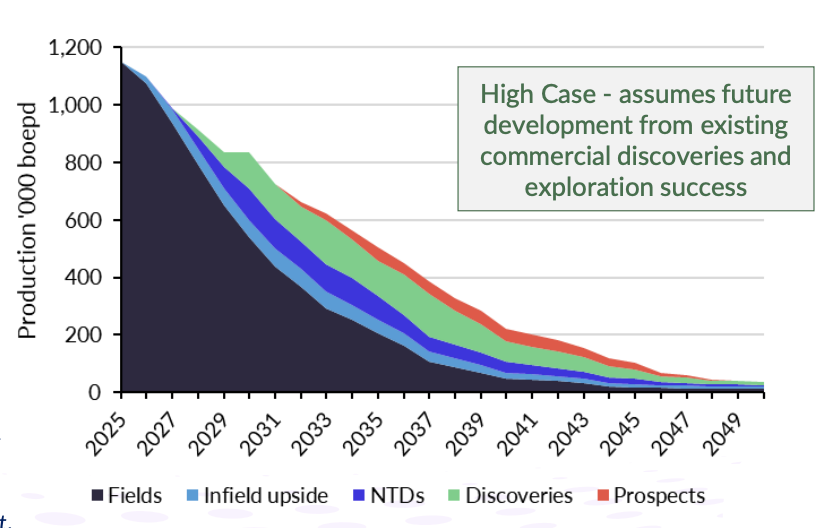
The OEUK-commissioned report also looked at an even more optimistic “no constraints” case for higher North Sea. However, the report authors, consultancy Westwood Energy, described this as “beyond realistic assumptions”. It said:
“The ‘no constraints’ case is considered to be beyond realistic assumptions given the current regulatory and fiscal conditions and investor sentiment. For this case to be realised, major industry change would be required.”
Similarly, OEUK has published a scenario for North Sea gas production that it calls “upside potential”, in which output is held close to current levels for the next decade.
It has used these scenarios to argue that the decline in North Sea gas output is “not inevitable”. However, the details behind these claims are opaque.
The “upside potential” scenario is based on what OEUK describes as “data provided by OEUK members” and it assumes that the government immediately scraps the “energy profits levy” (EPL, known as the windfall tax, see below).
OEUK claims that this scenario is “not speculative” and that it “clearly demonstrate[s] that the decline in potential supply indicated by NSTA forecasts is the result of policy choices”.
On this point, it is worth reiterating that the NSTA forecasts for gas barely changed in response to the election of the current government in 2024, as illustrated above.
Ultimately, while it is clear that most of the oil and gas that was once under the North Sea has already been burned, significant resources do remain.
The key question is how much of this remaining oil and gas is both technically and economically recoverable under current policies and prices – and if policies were changed.
OEIS’s Jack Sharples tells Carbon Brief that the North Sea is a “very mature basin” and that “nobody’s talking about increased production versus current levels”. He continues:
“Even if licences were to be made available for further exploration and production, that would result in a little bit of extra supply over the next 12 months, let’s say, but obviously not a huge amount…We’re just talking about slowing down the rate of decline.”
Sharples adds that, nevertheless, he thinks it is “worth maximising whatever we can produce in the North Sea”.
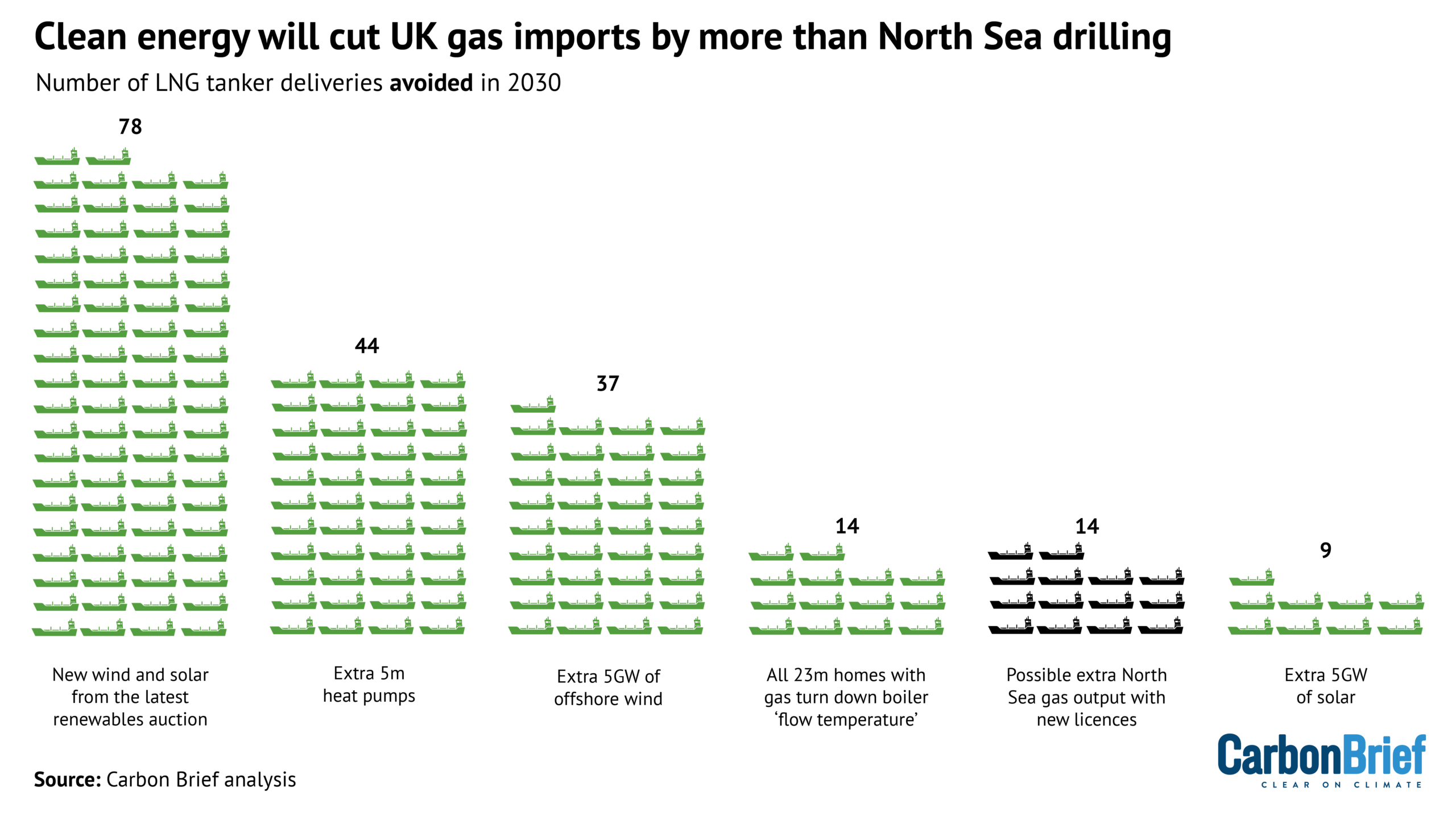
Recent Carbon Brief analysis found that expanding clean-energy supplies would have a larger impact on UK gas imports than an increase in North Sea drilling, as shown below.
(This analysis was based on NSTA projections of possible extra North Sea gas output, which amounted to 16TWh in 2030. If the OEUK “upside potential” scenario could be realised, the extra gas would amount to further 108TWh, equivalent to around 90 LNG tankers.)
An additional aspect to this relates to timescales. It takes an estimated 28 years for new licenses to result in new oil and gas production, according to official figures.
The industry says fields that already have licenses, such as Rosebank and Jackdaw, could be developed more quickly, if they receive planning consent. The previous Conservative government had consented to these fields being developed, but this was overturned in the courts. The Labour government is in the process of considering whether to approve them.
(The new wind and solar projects from the latest renewable auction, which concluded in February 2026, are set to be operating by or around 2030.)
In a March 2026 note, the UK Energy Research Centre (UKERC) said that drilling for oil and gas “will not reduce bills or deliver energy security”. Instead, it said that “demand reduction should be a core focus of UK gas security”.
In the longer term, the National Energy System Operator (NESO) says that meeting the UK’s net-zero target would cut the country’s dependency on imported gas to 78% below current levels, whereas failing to decarbonise would see imports rising by a third as production falls.
At a recent parliamentary hearing, Miliband told MPs that this illustrated why “decarbonisation is essential for energy security”. He added that turning away from net-zero would leave the UK “really, really exposed”.
Octopus boss Greg Jackson said in a recent government press release: “Every solar panel, heat pump and battery cuts bills and boosts Britain’s energy independence.”