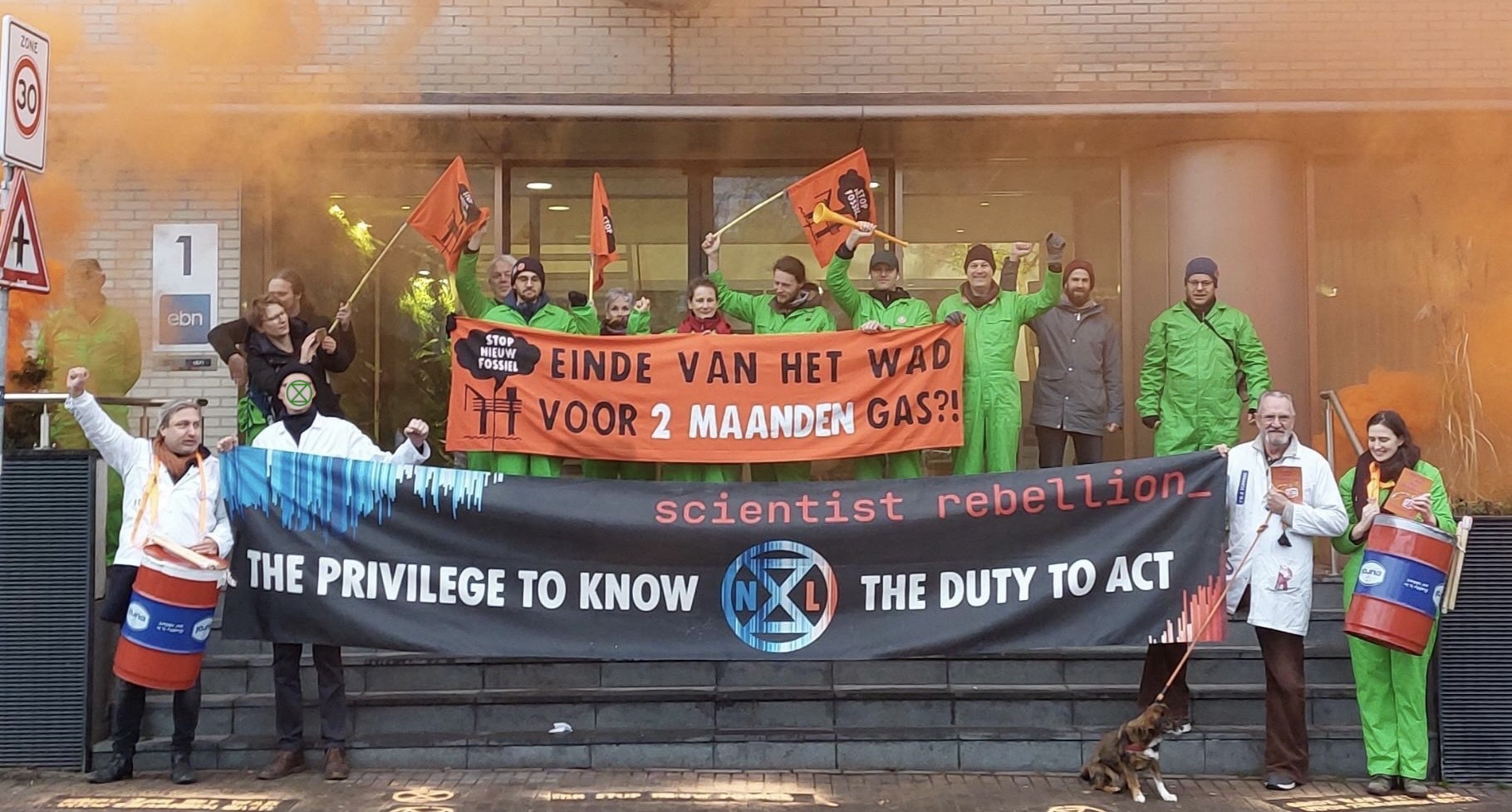
Sometimes the fact that science is (also) political is quite obvious. For instance, the European Commission wants to incorporate research and innovation into its geopolitical mission as a ‘critical asset’ for greater economic competitiveness and more influence on the world stage. Researchers are also expected to assist politicians by ‘providing scientific evidence to underpin policy choices’. That’s a good one.
Guus Dix
This article was previously published in Science Guide. 1
Even if, from within the scientific community, you raise a topic such as the ‘militarisation of the university’ for discussion, you can expect a political backlash. Scientists are apparently expected to blindly follow the trend towards armament; otherwise, they’re finished.
Occasionally, this ‘grassroots politics’ is also successful. For instance, after three years of campaigning, the committee of the Twente Business Days decided not to give the fossil fuel industry a platform at the latest careers fair. A courageous step forward.
The problem with climate change
In many cases, the political quest for ‘desirable science’ requires a little more explanation. Take climate change. For the majority of people, it is evident that this is a major problem. In that light, the question ‘what exactly is the problem with climate change?’ may sound naïve. Yet that is not the case. The definition of the problem determines what kind of solutions we seek, and whether we will ultimately prove capable of doing something about it.
Scientists play a role in this. But government and industry, as far more powerful players, are also trying to determine exactly what kind of problem climate change is.
Climate physics
Historically, global warming was initially viewed as a physical problem. In the late 1980s, climate physicist James Hansen delivered a landmark speech to the US Congress. Since then, physicists – in the face of large-scale disinformation campaigns by the fossil fuel industry – have continued to investigate the problem further and keep it on the agenda.
The crux of the matter remains that, in geological terms, the Earth is warming at an unprecedented rate. This warming is due to human activity. This is largely attributable to the burning of oil, gas and coal – each year more than the previous – with emissions from the meat and dairy industries coming a close second. The disruptive consequences are already visible in many places, and in the near future, according to a Flemish climate scientist, we run the risk of merely pumping water to keep from drowning. We will then be completely chasing after successive weather extremes, and we will lose our collective ability to tackle the problem ourselves.
How to trivialise economic damage
This brings us to a second definition of the problem: climate change as a techno-economic problem. It is extremely regrettable – and that is an understatement – that, of all the social scientists, economists were the first to determine what kind of problem climate change was. They assumed – and stubbornly insisted – that ninety per cent of the economy would not be affected by heatwaves, sea-level rise, drought, wildfires and floods. They also believed they could deduce from a combination of current productivity figures and temperature variations within regions that, economically speaking, everything would turn out fine in the future.
The trivialisation of the consequences of climate disruption gained a firm foothold in the IPCC’s third working group. In that working group, climate economists secured a permanent place alongside mitigation modellers – social scientists posing as natural scientists – with a penchant for technological solutions.
An existential problem
In thirty years of techno-economic climate policy, we have failed dramatically to reduce global emissions. Consequently, climate change has, thirdly, become an existential problem. On the one hand, there are fossil fuel companies that hold coal, oil and gas reserves more than ten times greater than what can be extracted if we are to stay below 1.5 degrees. This means that between thirteen and seventeen trillion dollars’ worth of fossil fuel assets must become worthless for us to meet our climate targets.
On the other hand, there are human societies that owe their existence to climate conditions that remained relatively stable for ten thousand years. Communities in the Global South, which are already being hit hard, face practically unliveable conditions in the future. A question of survival, then: do we write off corporate assets, or do we write off the Earth?
System failure
This brings us, finally, to climate change as a systemic problem. That sounds abstract, but it is not. One of the reasons why we find it so difficult to move away from fossil fuels is the underlying dynamics of an economic system geared towards infinite growth.
This compulsion to grow drives companies to expand ever further, and encourages economic elites to engage in increasing status consumption, with a corresponding rise in energy use – both renewable and fossil. This went hand in hand with a geopolitical system in which a select group of countries first expanded their territory (colonialism) and then their grip on raw materials (neo-colonialism).
Desired science underpins the status quo
With these four ‘problems’ of climate change, we are back to politics. The scientific definition of the problem is recognised by many politicians, although climate denial is unfortunately back, having never really gone away. Over the past thirty years, the second definition has been widely embraced, defining climate change as an economic problem that is not particularly urgent but can be solved through technological innovation. Consequently, both climate policy and science funding continue to this day to exhibit a very strong bias in that direction.
Politics has no use for the third problem. The prevailing ideology among policymakers is one of ‘dialogue’ and ‘collaboration’ with established companies, which means that the fossil fuel industry currently enjoys easy access to scientists and policymakers and, from that position, undermines sustainability policy. And as a scientist, you mustn’t even bring up the fourth problem.
Scientific evidence that economic growth and sustainability do not go hand in hand is simply ignored. Or, as the European Commission put it – unintentionally honestly –: we primarily ask researchers to “provide scientific evidence to underpin policy choices”.
For first comes the politics of policy choices, and only then the search for the desired science to support them.

Guus Dix is an Assistant Professor of the Sociology of Science and Technology at the University of Twente. As a researcher, he studies the relationship between scientists, policymakers, and fossil fuel companies. Recognising that radical social change will not come from another lecture or scientific paper, Guus has been an active climate campaigner with Extinction Rebellion and Scientist Rebellion for over five years.
- For links to references, please refer to the Dutch version of this article.[↩]