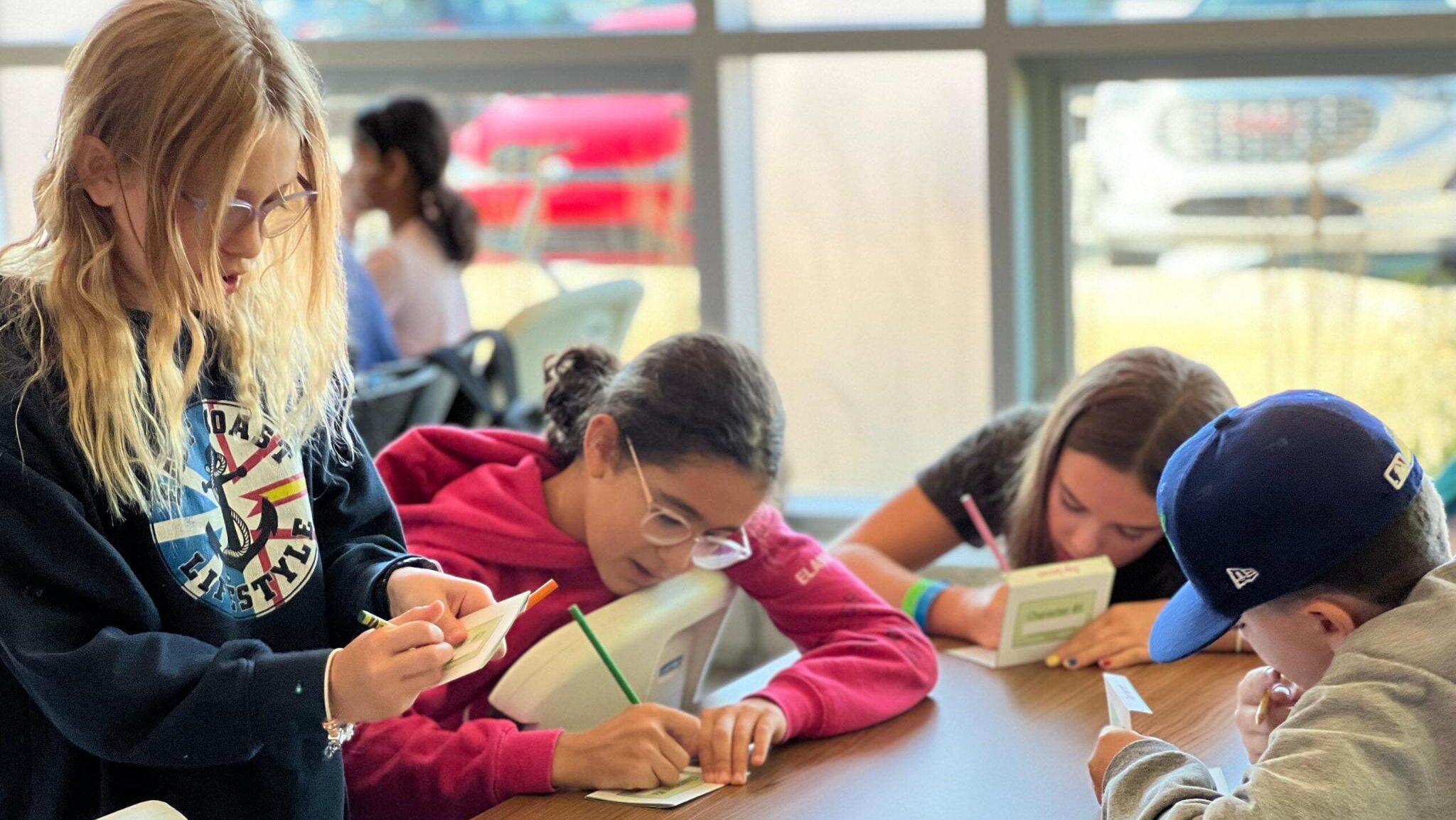
Young people worry about the climate – we know that. But what does education do about those concerns? International research shows: too little. And that can be done differently – especially if we also take the children’s age into account.
Climate education falls short
What can schools and parents do to equip young people for the climate crisis?
Climate anxiety, eco-anxiety, climate stress – there are now dozens of words for what young people feel when they think about the climate crisis. Researchers counted no fewer than 173 different descriptions in scientific literature of how young people between the ages of 10 and 29 react to climate change. 1 It ranges from sleep problems to financial worries, from grief over lost nature to hope. So it is about much more than just fear.
Those concerns are real. In the Netherlands, 66 to 71% of young people aged 18 to 24 indicate that they are worried about climate change. 2. Internationally, 59% of young people aged 16 to 25 are very to extremely worried. 3. Fortunately, it is not paralyzing; research shows that even young people with relatively high levels of climate anxiety remain engaged and exhibit climate-friendly behavior. 4
The question is: what does education do with that engagement?
Education is missing opportunities
International research by UNESCO into curricula in 85 countries reveals a shocking picture: 69% of the curricula examined contain no reference whatsoever to climate change. 5. And where climate is addressed, the emphasis lies almost exclusively on cognitive knowledge – facts, causes, consequences. What is structurally missing are the socio-emotional, relational, and action-oriented dimensions: how do you feel about it, how do you relate to others and to nature, and what can you do yourself?
Young people not only suffer from the climate crisis; they also have the least control over its outcome. This can lead to what researchers call the futility gap: the feeling that individual action is pointless as long as society as a whole stands still. 6 This is precisely why it is so important that young people learn that they do have influence -not only individually, but also together.
Younger children and teenagers require a different approach
Not all children are the same, and an effective approach takes age into account. Research among nearly 1,900 children aged 7 to 18 shows that young children are naturally strongly connected to nature, but that this connection declines as they enter their early teens. 7 This so-called teenage dip has implications for how climate education aligns: it is precisely during primary school age that natural engagement with nature is greatest, and thus an excellent opportunity to nurture and deepen that connection. If that opportunity is missed, it is more difficult (but not impossible) to restore that connection later on.
For younger children (primary school and lower secondary education), this means focusing on direct nature experiences, learning through play outdoors, and connecting climate to their own living environment. For older students (upper secondary), it works better to focus on critical thinking, collective action, and the feeling that their voice matters -even if the spontaneous connection with nature is somewhat further away.
What can parents and teachers do?
Good news: you don’t have to be a climate expert to help young people. What works is attention for their concerns -and looking together for what they can do themselves. Research shows that strengthening psychological agency – the feeling that you can do something about it – is fundamental to children’s resilience. 8
Concrete tools:
- Take concerns seriously, without exaggerating them. Climate anxiety is a healthy reaction to a real problem. Acknowledge that, and truly listen.
- Focus on the small andtheimmediate. What can you concretely change at home or at school? Getting a grip on small things helps.
- Talk about feelings, not just facts. Many lessons focus on what climate change is – rarely on how it feels and what you can do about it.
- Go outside, especially with young children. Nature-based learning strengthens both mental health and understanding of climate change. 8 The sooner, the better: the connection with nature that children build at a young age is a solid foundation for later climate awareness. 7
- Show your own doubts. Young people see through inconsistency. Honesty about what you find difficult yourself works better than a perfect story.
- Connect personal action to collective change. Taking shorter showers is good, but we won’t solve the climate crisis individually. Also teach young people about collective action and political involvement.
Hope is an attitude
The climate crisis is a fact. But how young people deal with it depends largely on the adults around them. Young people who feel they can do something are more resilient – not blindly optimistic, but actively hopeful.
Education, and we as adults, can nurture or undermine that attitude. A student who learns that her voice counts, who sees that her school lives up to her words, who is allowed to say at home that she is afraid: that student stands stronger. The task is not: protect young people from the climate crisis. The task is: equip them to deal with it and contribute to it.
Literature
Becht, A., Spitzer, J., Grapsas, S., van de Wetering, J., Poorthuis, A., Smeekes, A., & Thomaes, S. (2024). Feeling anxious and being engaged in a warming world: climate anxiety and adolescents’ pro – environmental behavior. Journal of Child Psychology and Psychiatry, 65(10), 1270–1282.
Hickman, C., Marks, E., Pihkala, P., Clayton, S., Lewandowski, R. E., Mayall, E. E., & Van Susteren, L. (2021). Climate anxiety in children and young people and their beliefs about government responses to climate change: A global survey. The Lancet Planetary Health, 5(12), e863–e873.
Ipsos I&O (2019–2025). Duurzaam denken, duurzaam doen. Amsterdam: Ipsos I&O.
Okamoto, S., Nagabhatla, N. & Oakes, R. (2026). How adults can help children move from climate anxiety to resilience. The Conversation. https://theconversation.com/how – adults – can – help – children – move – from – climate – anxiety – to – resilience – 274141
Price, E., Maguire, S., Firth, C., Lumber, R., Richardson, M., & Young, R. (2022). Factors associated with nature connectedness in school – aged children. Current Research in Ecological and Social Psychology, 3, 100037.
UNESCO (2024). Climate change and sustainability in science and social science secondary school curricula. Parijs: UNESCO.
Watson, D. & Lawrance, E. (2026). Eco – anxiety: how do young people relate to the climate crisis? The Conversation. https://theconversation.com/eco – anxiety – how – do – young – people – relate – to – the – climate – crisis – 277520
- Watson, D. & Lawrance, E. (2026). Eco-anxiety: how do young people relate to the climate crisis? The Conversation, March 25, 2026[↩]
- Ipsos I&O (2019–2025) Sustainable thinking, sustainable doing[↩]
- Hickman, C. et al. (2021) Climate anxiety in children and young people and their beliefs about government responses to climate change: A global surveyThe Lancet Planetary Health, 5(12), e863–e873[↩]
- Becht, A. et al. (2024). Feeling anxious and being engaged in a warming world. Journal of Child Psychology and Psychiatry, 65(10), 1270–1282.[↩]
- UNESCO (2024) Climate change and sustainability in science and social science secondary school curricula. Paris: UNESCO.[↩]
- Okamoto, S., Nagabhatla, N. & Oakes, R. (2026). How adults can help children move from climate anxiety to resilience. The Conversation, 2026.[↩]
- Price, E., Maguire, S., Firth, C. et al. (2022). Factors associated with nature connectedness in school – aged children. Current Research in Ecological and Social Psychology, 3, 100037[↩][↩]
- Okamoto, S., Nagabhatla, N. & Oakes, R. (2026). How adults can help children move from climate anxiety to resilience. The Conversation, 2026[↩][↩]