
We are facing surging oil prices and rising costs for fertilisers, food and other commodities. Trump’s reckless actions in Iran are pushing the global economy to the brink of an economic crisis. Many are seizing the opportunity to start drilling for oil and gas in the North Sea. This Carbon Brief paper debunks the myths surrounding drilling in the North Sea.
This paper appeared first in Carbon Brief on 25 March 2026 and was written by Daisy Dunne, Josh Gabbatiss, Molly Lempriere and Simon Evans. This text has been republished here under a CC license. We will publish it in five parts.
The Iran war has triggered another fossil-fuel energy crisis, with surging global prices and increasing concerns over energy security. In the UK, as in the Netherlands, many newspapers, opposition politicians and other public figures have used the crisis to argue in favour of issuing more licences for oil and gas drilling in the North Sea.
These arguments have also been amplified in AI-generated posts on social media, shared by fake accounts that usually post anti-immigrant and anti-Muslim content. However, many of these arguments rest on false or misleading claims about the impact that further drilling could have on the UK’s bills, energy security, emissions and tax revenue.
The North Sea is a “mature basin” where production has been falling for decades, because most of the oil and gas it once contained has already been extracted. While it would be possible to slow the rate of decline in oil and gas output from the North Sea, the quantities that would be economic to extract are disputed.
Overall, the transition to clean-energy supplies is expected to be far more effective at boosting UK energy security and reducing reliance on imports. Moreover, the climate-change arguments for limiting fossil-fuel production, which have been made by scientists, the UN secretary general and even the Pope, remain as valid as ever.
Below, Carbon Brief factchecks some of the most common claims about North Sea oil and gas. (Most of these factchecks also apply to other countries around the North Sea, susch as Germany and The Netherlands.)
- FALSE: ‘Reopening the North Sea would lower bills’
- MISLEADING: ‘Energy from the North Sea generates a lot less CO2’
- FALSE: ‘Britain is a resource-rich nation that has chosen dependency’
- FALSE: North Sea is ‘best way to protect us from volatility and provide energy security’
- MISLEADING: ‘The head honchos of the green lobby say we should drill’
- FALSE: ‘The UK is the only country in the world banning new oil and gas licenses’
- MISLEADING: ‘With new North Sea licences would come thousands of jobs’
- MISLEADING: North Sea drilling ‘would secure a rush of revenue into the Treasury’
- FALSE: Ed Miliband is an ‘anti-North Sea’ climate change ‘fanatic’
- FALSE: ‘We share the same basin with Norway…there is not a geological difference.”
FALSE: ‘Reopening the North Sea would lower bills’
Many right-leaning newspapers and commentators have falsely argued that opening up new oil and gas fields in the North Sea would lower energy bills in the UK. There is no evidence to support such claims. Indeed, numerous experts have explained that new drilling would make no difference to bills in the UK.
For example, the Daily Express carried fact-free assertions from the hard-right, climate-sceptic Reform party on its frontpage under the headline: “Get drilling to stop bills soaring.” Despite the UK not using oil to generate power, it claimed:
“Open[ing] up the UK’s biggest oil field [would] stop power bills soaring.”
At the beginning of March, US president Donald Trump told the Sun that his advice to UK prime minister Keir Starmer would be:
“Open up the North Sea. Immediately. Your energy prices are through the roof.”
In the Daily Telegraph, an “energy consultant” called Kathryn Porter, who has authored “papers” for climate-sceptic lobbyists, listed why she thinks more drilling could cut energy bills under the headline: “Reopening the North Sea would lower bills.”
On Twitter, Reform said the Labour and Conservative governments had “failed the British people” by “refusing to drill in the North Sea”. It added that more drilling would make “Britain energy independent once again” and “bring down bills”.
Contrary to these claims, numerous experts have said that further drilling in the North Sea would do nothing to cut bills, because UK energy prices are set on international markets.
In 2022, the Climate Change Committee (CCC) wrote that increased UK extraction was not expected to “materially affect global oil or gas prices, as the UK energy market is highly connected to international markets and the potential supply [is] relatively small”.
It added that, even if all proven UK reserves and resources of gas from new fields were extracted, this would only meet about 1% of European demand each year up to 2050.
Jack Sharples, senior research fellow at the Oxford Institute for Energy Studies (OEIS), tells Carbon Brief that “you’re not going to bring prices down versus the current level, because you’re not going to be able to produce very much more [from the North Sea]”.
The Labour government has made similar arguments, saying in a “factsheet” on the Iran crisis that the UK is a “price-taker…not [a] price-maker”. It said:
“Future exploration in the North Sea is too marginal to make a difference to the overall supply in an international market…New licences to explore new fields wouldn’t make any difference to the prices set by international markets and paid by UK billpayers.”
Even shadow energy secretary Claire Coutinho, who has advocated strongly for further drilling, admitted in 2023 that new licenses “wouldn’t necessarily bring energy bills down”.
Coutinho’s party has launched a “get Britain drilling” campaign, statingthat “the Conservatives will extract every drop of oil and gas from the North Sea and cut your energy bills”.
However, Badenoch has conceded that any proposed cuts to energy bills would not come from extracting more fossil fuels, but rather from existing pledges to “scrap green taxes and remove VAT from domestic energy bills”.
The North Sea is a “mature basin”, with around 90% of what it contained “already drained dry”. Most of what is produced for the basin is now oil, around 80% of which is exported.
In addition, oil and gas reserves are owned by private companies once licences are issued and the fuel is sold at international rates. Therefore, whether it is produced in the North Sea or elsewhere, its price is driven by the global market.
Moreover, the limited quantity of gas left in the ageing North Sea basin would do little to impact international markets and, thus, little to impact international prices.
Recent analysis by the Smith School at the University of Oxford found that, even if the UK maximised North Sea oil and gas and used all revenues from the sector to subsidise lower energy bills, the impact would be limited. Under this unlikely scenario household bills could fall between £16 and £82 per year, or 1-4.6% a year.
The fact that further oil and gas production in the North Sea would have a limited impact on energy bills has been noted repeatedly, even by those in favour of drilling in the North Sea.
For example, in a separate comment piece in the Daily Telegraph calling on the UK to “max out on both renewables and North Sea oil and gas”, world economy editor Ambrose Evans Pritchard wrote:
“Reopening the North Sea would not make any difference to the current crisis, nor any difference to gas and petrol prices in the UK, since the volumes are too small to shift the traded global market.”
As such, the UK Energy Research Centre (UKERC) explained in a recent note:
“Squeezing additional oil and gas production from the UK may be technically possible, but it will have [a] negligible impact on the UK cost of living”.
MISLEADING: ‘Energy from the North Sea generates a lot less CO2’
Many North Sea advocates argue that drilling more in the basin would mean lower carbon dioxide (CO2) emissions, due to the high emissions from imported fossil fuels.
This is a line often used by the oil-and-gas industry, with the trade body Offshore Energies UK (OEUK) stating that “LNG cargoes…are four times more carbon intensive than homegrown gas”.
Additionally, it is an argument that is sometimes used by commentators who – in other circumstances – would not be making the case for low-carbon policies.
For example, in a Mail on Sunday column, the climate-sceptic journalist Andrew Neil wrote that “giving the North Sea a new lease of life” would:
“Even lower carbon emissions (because piping in energy from the North Sea generates a lot less CO2 than importing it).”
Conservative shadow energy secretary, Claire Coutinho, has also used this approach to question the government’s supposed opposition to North Sea drilling, writing in the Daily Telegraph:
“Doing so in the name of climate change when our own gas has four times fewer emissions than the LNG we’ll need to import instead? Unforgivable.”
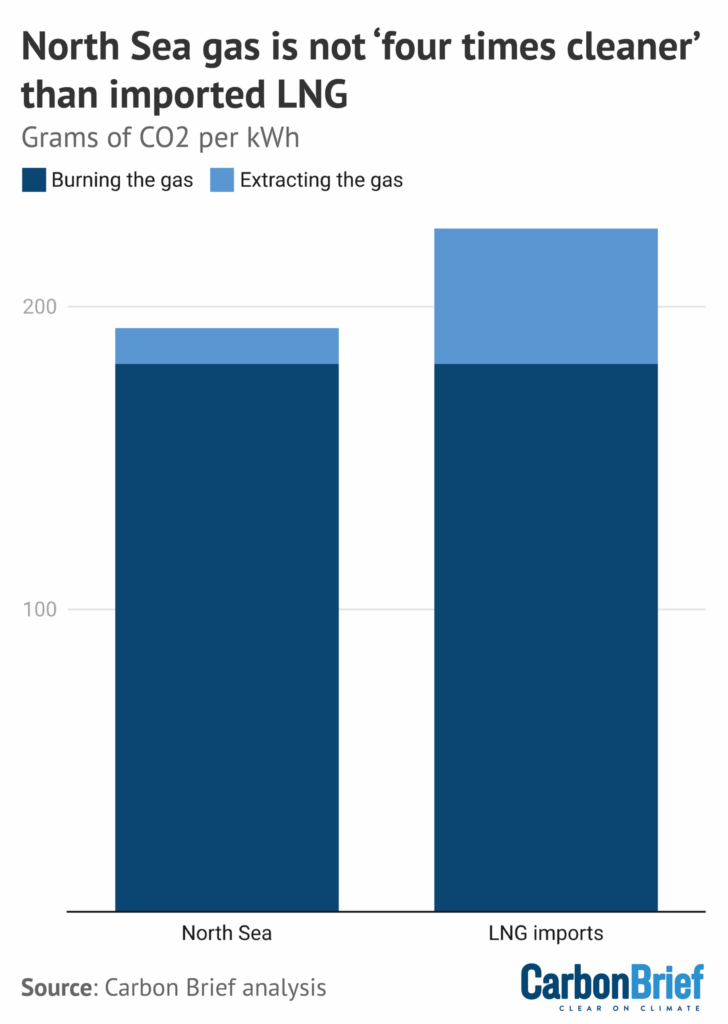
The claim that UK gas from the North Sea produces “a lot less CO2” – and particularly the commonly cited “four times fewer emissions” figure used by Coutinho and OEUK – is misleading.
It references the fact that imported LNG has higher overall emissions than North Sea gas, due to the energy-intensive processes needed to liquify, transport and regasify it.
However, as the chart below shows, the vast majority of emissions from gas result from burning it to produce energy.
When CO2 from gas combustion is taken into account, North Sea gas emissions are not four times lower than LNG emissions, but 15% lower.
The UK is reliant on LNG imports from a handful of countries, notably the US and Qatar. However, at present these imports make up only around 15%of the UK’s gas.
Of the remaining gas used in the UK, roughly half is produced domestically and the rest comes via pipeline from Norway. Norwegian pipeline gas has even lower emissions than UK supplies.
More broadly, analysis by the Climate Change Committee in 2022 found that, despite the small “emissions advantage” of UK domestic production replacing imports, this could be wiped out if increased UK production led to more fossil-fuel production overall.