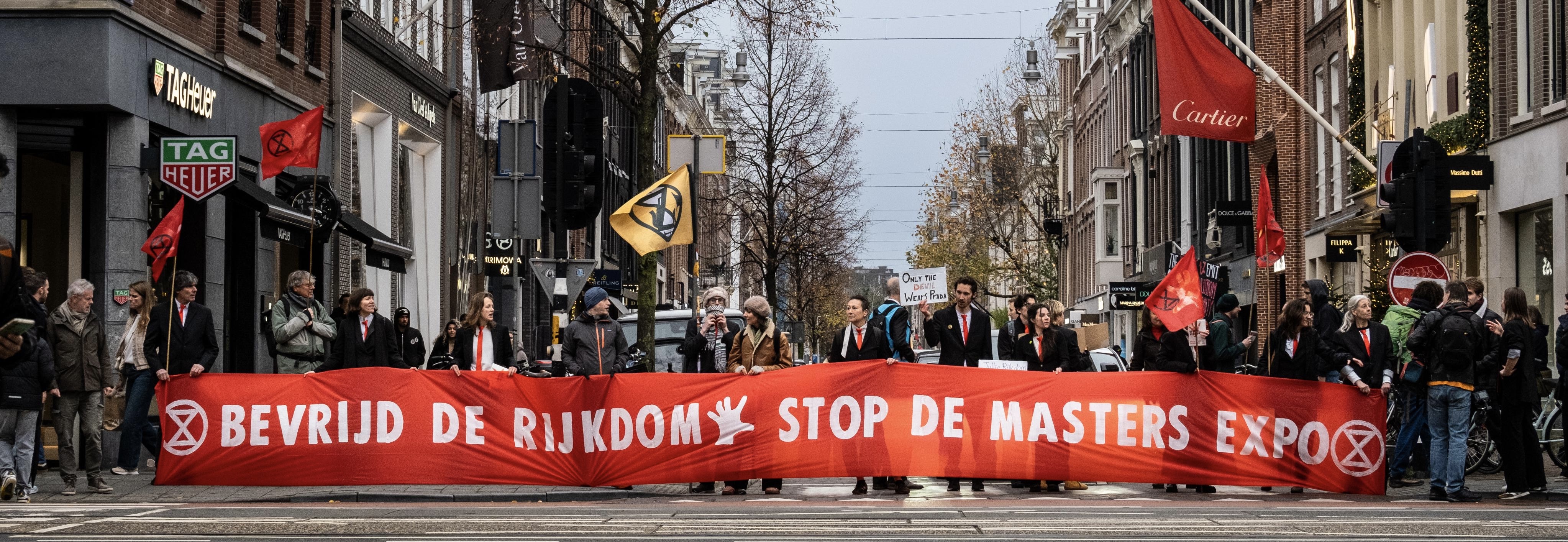
The myth of the ‘self-made millionaire’ conceals a system of privilege and exploitation
Eva de Bock & Anna Sach
Welcome to the community of greatness. Be here & be great.
At first glance, this bombastic, elitist language seems to come straight from Trumpian political theatre, far removed from the down-to-earth attitude of the Netherlands. Yet these words are not from an American election rally: they appear, without any irony, on the website of the Dutch Masters Expo, formerly the Millionaires Fair, which will take place next week in Amsterdam. Yachts, private jets and luxury holiday homes are on display at this fair. This celebration of greed rests on the persistent illusion that extreme wealth is earned through hard work, a myth that conceals and perpetuates an unjust reality.
A persistent myth
In reality, most of the wealth of billionaires is the result of inheritance, cronyism and monopoly positions. In the Netherlands, excessive wealth is often passed down from generation to generation, made possible by low inheritance tax rates and tax benefits such as the Business Succession Scheme. Moreover, many wealthy families still live off the plundered wealth of the colonial era.
The super-rich also pay much less tax on average than ordinary people, because income from wealth is taxed at a significantly lower rate than income from work, and because the super-rich often use foreign structures to evade tax. In addition, having money yields more than earning money, so hard work can never compete with wealth growth. Extreme wealth is therefore not usually the result of hard work, but of privilege, tax tricks and the exploitation of those who do work hard.
The price of inequality
These unfair conditions are at odds with the image of the Netherlands as a reasonably egalitarian polder country. However, the Netherlands has the second highest wealth inequality of the OECD countries, after the United States. The richest 0.1 per cent of Dutch households own about 10 per cent of the total wealth, and this inequality is still growing.
While at the Masters Expo a few super-rich people salivate over the choice of their next yacht, ordinary citizens struggle to find affordable housing, pay for necessary care, and provide for basic needs. It is an exhibition of pure extravagance. Society builds, produces, and works itself to death to serve the excesses of the super-rich. This simply leaves fewer resources and people for essential services, and makes everything more expensive for ordinary people. As a result, we live in a stripped-down version of the society we could live in if there were fair sharing.
The behaviour of the super-rich is not only harmful in the present, but also threatens our future: someone in the richest 0.1 per cent emits more CO₂ per day than someone in the poorest half of the world’s population does in an entire year, while the consequences of the climate crisis mainly affect the people who have contributed the least to it. In 2019 alone, emissions from the richest 1 per cent worldwide caused 1.3 million heat-related deaths.
Redistribution is necessary and possible
The solution to this extreme injustice is redistribution: when money no longer accumulates in the hands of a handful of super-rich individuals, it can flow back into society to be used to tackle urgent social problems. One of the proposed measures is to set an upper limit on personal wealth. Economist and professor Ingrid Robeyns advocates a limit of 10 million euros, because wealth above that amount contributes little to quality of life.
In addition, instruments such as a progressive wealth tax, higher inheritance tax, adjustments to the Business Succession Scheme and stricter measures against tax avoidance could be used. Such measures are being proposed in both national and international politics, for example in France, the United Kingdom and the United States. Switzerland already has a wealth tax. These measures can also be linked to climate pollution. The ‘carbon wealth tax’ is a proposal in this direction and, according to CE Delft, would save 4.8 megatons of CO2 annually, more than the total emissions of Albania, and also generate 48.9 billion euros.
This money could be used to provide affordable housing, guarantee access to healthy food, reverse cuts in education and healthcare, finance projects to combat the climate crisis and adapt to its consequences, and make decolonial reparations to countries in the Global South. The majority of Dutch people believe that the super-rich should be taxed more heavily, especially if the proceeds benefit the most vulnerable in society.
Behind the sparkling champagne glasses and pompous slogans of the Masters Expo lies a dark truth: an elite world built on inherited and stolen wealth. It is a carnival of clownish distastefulness that glorifies a social and moral failure. A just system is not a utopia, but a future that we can achieve with concrete steps.