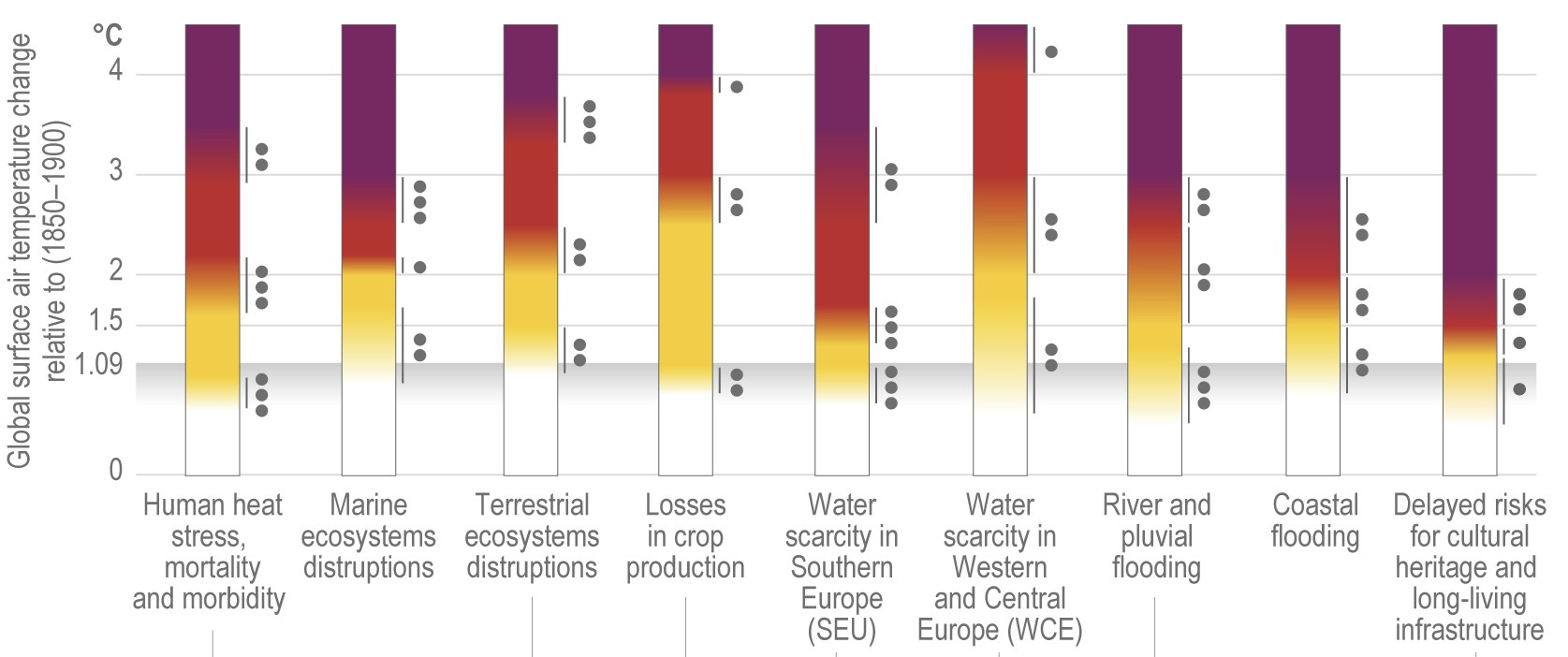
Moderate global warming creates a risk of climate impacts that are more severe than the most-likely impacts of high global warming.
Summary of a News & Views article in Nature (25 March 2026) by Rachel Warren, 1 discussing a paper by Bevacqua et al. in the same issue. 2
The Paris Agreement targets a rise of less than 2 °C above pre‑industrial levels, yet the uncertainty inherent in climate‑model ensembles means that even this “moderate” warming can generate impacts as severe as those usually associated with higher temperature increases. Bevacqua et al. (p. 946) demonstrate that, at a 2 °C rise, exposure of critical systems—such as the global breadbasket, densely populated urban areas, and fire‑prone forests—to climate‑related hazards (drought, intense precipitation, and wildfire‑favourable weather) can match or exceed levels projected for 3 °C–4 °C warming. This finding underlines the need for climate policy to incorporate worst‑case scenarios, not only the most likely outcomes.
The authors’ methodology aligns with the World Climate Research Programme’s “Safe Landing” recommendations, which call for the identification of low‑probability, high‑impact risks with global ramifications. Using CMIP6 model outputs, they quantified regional temperature changes and mapped spatial patterns of climate‑impact drivers for each model. They introduced a “global climatic impact‑driver” metric that captures how exposure to each hazard changes per degree of warming. By ranking models on this metric and selecting the top and bottom 10 % as worst‑ and best‑case outcomes, they highlighted the breadth of possible futures.
This is a low-probability, high-impact risk that we should not take.
Their analysis shows that, even at 2 °C, the most adverse model outcomes can be more extreme than the average projections for 3 °C or 4 °C. Consequently, a precautionary approach—aiming well below the 2 °C threshold—is required to avoid such extremes with high confidence. Policymakers should therefore consider both the most probable and the less likely, more severe outcomes when designing mitigation and adaptation strategies.
While global climate sensitivity (the temperature response to a CO₂ doubling) has received considerable policy attention, uncertainties in regional exposure to hazards have been less scrutinized. Existing risk assessments usually present error margins but seldom explore the tail‑end of the distribution. Bevacqua et al. argue that risk assessments need to focus on extreme outcomes, especially in regions that are pivotal for food security or ecosystem services. Their work could inform updates to the IPCC’s “burning‑embers” diagrams, which colour‑code risk levels based on evidence strength, magnitude, likelihood, permanence, and importance of impacts.

Future research should extend this extreme‑risk framework to other vital systems—ocean health, coastal zones, human health, and infrastructure—and incorporate vulnerability and adaptive capacity, which the current study omitted. The United Nations Environment Programme projects that, under current policies, warming will reach about 2.8 °C, underscoring the urgency of rapid mitigation. To keep warming below 2 °C and limit exposure to the worst‑case scenarios identified by Bevacqua et al., global CO₂ emissions must fall to net‑zero by the early 2050s, demanding swift transitions from fossil fuels to low‑ or zero‑carbon energy sources.
- Warren, R. (2026). Extreme climate outcomes could still occur with just 2 °C of global warming. Nature, 651(8107), 888–890. https://doi.org/10.1038/d41586-026-00640-7[↩]
- Bevacqua, E., Fischer, E., Sillmann, J., & Zscheischler, J. (2026). Moderate global warming does not rule out extreme global climate outcomes. Nature, 651(8107), 946–953. https://doi.org/10.1038/s41586-026-10237-9[↩]
- Figure 13.28 in Bednar-Friedl, B., R. Biesbroek, D.N. Schmidt, P. Alexander, K.Y. Børsheim, J. Carnicer, E. Georgopoulou, M. Haasnoot, G. Le Cozannet, P. Lionello, O. Lipka, C. Möllmann, V. Muccione, T. Mustonen, D. Piepenburg, and L. Whitmarsh, 2022: Europe. In: Climate Change 2022: Impacts, Adaptation and Vulnerability. Contribution of Working Group II to the Sixth Assessment Report of the Intergovernmental Panel on Climate Change [H.-O. Pörtner, D.C. Roberts, M. Tignor, E.S. Poloczanska, K. Mintenbeck, A. Alegría, M. Craig, S. Langsdorf, S. Löschke, V. Möller, A. Okem, B. Rama (eds.)]. Cambridge University Press, Cambridge, UK and New York, NY, USA, pp. 1817–1927, doi:10.1017/9781009325844.015.[↩]