Sander Otte
My name is Sander Otte,1 professor of technical physics at Delft University of Technology. My area of expertise is quantum physics. You may not immediately associate quantum physics with the climate problem. However, there is an important connection. Only quantum physics can explain why a carbon dioxide molecule absorbs infrared radiation, while a nitrogen or oxygen molecule does not. The greenhouse effect is ultimately a quantum physical phenomenon.
But that is not the reason I am standing here today. I am not here because of my expertise. I am here as a scientist in the broadest sense. Because science is being undermined. For decades now, on a subject where the undermining of science will ultimately have disastrous consequences for society. I therefore see it as my responsibility as a professor to speak out against this as loudly as I can.
10 years of ‘Paris’
Today we are celebrating the anniversary of the Paris Agreement. In the Paris Agreement, we agreed to limit global warming to 1.5 degrees, or at most 2 degrees. This wording creates the illusion that there is not much difference between these two values. But nothing could be further from the truth. When it comes to global warming, every tenth of a degree makes a huge difference. Even if all countries adhere to the agreements made, which is highly questionable, we are now heading for a warming of 2.5 to 3 degrees compared to pre-industrial levels. The consequences of this are unimaginable.
In the next few minutes, I would like to outline a number of consequences that personally concern me greatly. Of course, one must always be cautious with predictions. However, all the consequences I will mention are supported by science. If there is any uncertainty, it lies in the exact moment when they will occur, not in whether they will occur.
2100
I will do this in three time scales, starting with a time scale that is still quite far in the future: the end of this century. Based on everything I have read, I expect that by around the year 2100, climate change will lead to direct disruption here in the Netherlands. This will take the form of sea level rise and heavy rainfall causing rivers to flood.
And above all: due to the cessation of the warm Gulf Stream. If that happens, which is a very realistic scenario, we can expect winters of -20 degrees here. We will then have a climate similar to that of northern Canada. In such a climate, it will be impossible to maintain the population density we know today.
2050
For those who are now thinking, ‘Oh well, whoever is alive then will have to deal with it,’ I will now move to a time scale that is a little closer: the middle of this century. In about 25 years, I expect economic disruption. This will be caused by climate damage in the Global South, where large areas will become uninhabitable. These are areas where our low-wage labour currently takes place and where many of our raw materials come from.
Economic disruption will also occur because real estate and infrastructure will become uninsurable in regions with frequent forest fires and floods. It will be like the coronavirus crisis, but much worse. And permanent instead of temporary, with all the consequences that entails for our pensions and savings. Never before has there been such a great threat to the stability and security of our society. It is astonishing that this is not being given the highest priority in The Hague.
Now: political crisis
That brings me to the third time scale: the present. At the moment, we are not yet seeing real climate disruption or economic disruption, but political disruption. Multinationals, who know full well that their profit model is coming to an end, are doing everything they can to protect their private interests. In the US, we see how Big Tech and Big Oil are conspiring with the radical right and jointly attacking science and the free press. This trend is also undeniably evident in the Netherlands.
What I want to argue is that the political crisis we are currently witnessing here cannot be viewed separately from the climate crisis. It is the climate crisis. Or at least a harbinger of it. Although the climate problem is being hushed up at the negotiating table, the climate crisis is omnipresent in the political arena in The Hague. In the form of obstruction, diversionary tactics and procrastination.
And just as the climate problem will not go away on its own, neither will this political crisis. Anyone who thinks that if we just get a stable government now, we will eventually focus on the climate problem, is mistaken. The political forces that have been awakened will always go to extremes to keep effective climate policy off the political agenda. And they will get away with it as long as we allow them to undermine science.
At this point, you may be wondering, ‘Is this professor going to say anything positive? I can imagine that you need to hear that. But the answer is no, I’m not going to do that. Because there is no reason to. And besides, there are already enough people who always want to put a positive spin on this story, simply because it is socially desirable. This leads to a spiral of false positivity that causes further delays. I’m not going to participate in that.
Recommendation
What I do want to do is make a recommendation. In my view, the minimum required to tackle this problem is a political body that is given a mandate and has power, but is set up in such a way that it can look beyond the four-year cycle of our parliamentary democracy. In other words, a body that transcends the term of office of any government and can truly focus on the long-term interests of society. How exactly this would work in constitutional terms is not for me, as a quantum physicist, to say. But I am absolutely certain that something like this is needed.
I will leave it at that for today. Thank you for your attention.
- Sander Otte gave this speech during the launch of the Climate Wiki on 12 December in The Hague. ↩︎
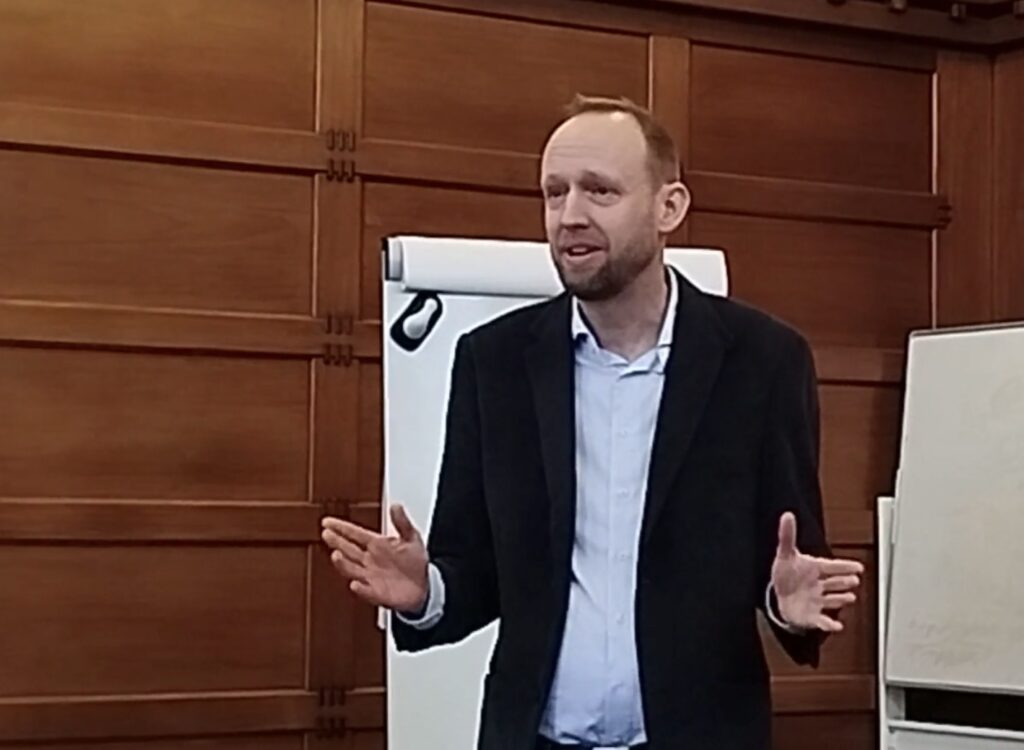
Sander Otte is a professor of quantum physics in Delft and spokesperson for Scientist Rebellion.