Sergej van Middendorp
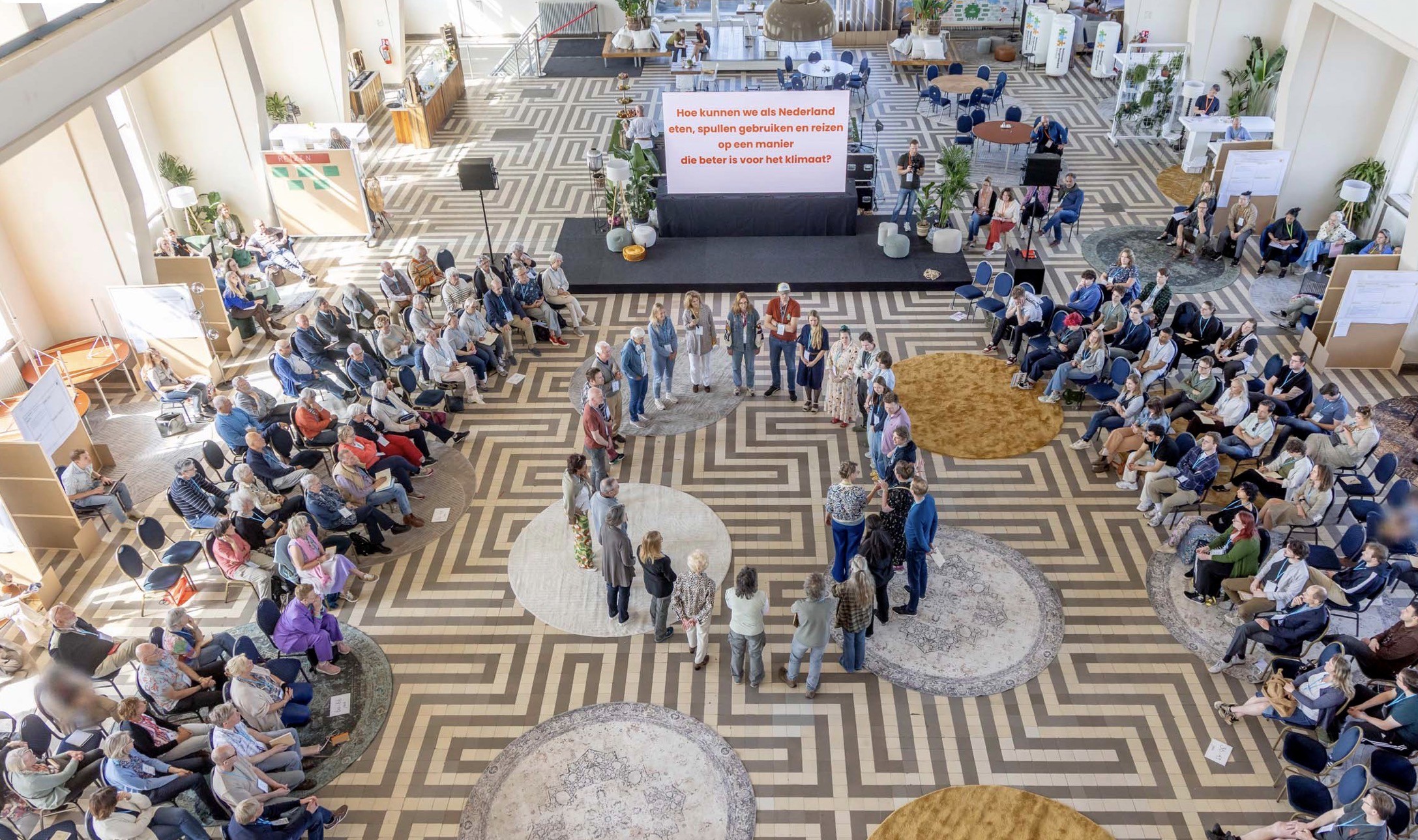
On Monday 1 December, the National Citizens’ Climate Assembly presented its advice to the government. In a comprehensive report,1 the 175 Dutch citizens2 who formed the assembly made 23 recommendations in response to the question posed by politicians to the citizens’ assembly: “How can we, as the Netherlands, eat, use goods and travel in a way that is better for the climate?” This was the first national citizens’ assembly in the Netherlands, and there was therefore a great deal of interest in the process and its outcomes. I was initially critical and sceptical about this citizens’ assembly. I remain critical, but my scepticism has turned into cautious hope.3
Scientist Rebellion pursues climate justice and makes three demands: be honest about the reality of the climate and ecological crises, do what is necessary to reverse them, and involve citizens in the democratic decision-making process about the measures to be taken through citizens’ assemblies. We are therefore also very interested in this first national citizens’ assembly.
Scepticism
At the beginning of this year, after hearing the questions posed by politicians to the deliberation, I was sceptical and critical. With such a limited playing field, major issues such as ending fossil fuel subsidies and the poisoning of our living environment were addressed with euphemisms and simple language focused on the symptoms rather than the causes. I thought the consultation had already been hijacked by the current political administration, which is steering us straight towards the abyss of ‘hothouse earth’.
But the report presented last week shows that the citizens’ assembly approached the question in a reasonably systematic way and included a broader analysis of the causes in its recommendations than the question would suggest. The recommendations relate to the social systems that produce greenhouse gas emissions. They identify areas of concern that need to be addressed in order to enable systemic change. These include the role of the government, local authorities and the business community in implementation, as well as the impact on and additional measures required for the social domain.
It is also striking that the citizens’ assembly did not limit itself to the question. It also added general recommendations that demonstrate an awareness of the role of citizens’ assemblies as a complementary instrument in the political system. Seven recommendations concern the continued use of citizens’ wisdom in policy-making on complex issues, such as the climate crisis.
The report shows how citizens’ assemblies can function as a complementary instrument in the democratic system. From 70,000 invitees and 4,000 responses, 175 people were selected at random, representative of the Netherlands in terms of gender, opinion on climate policy, age, province, and education. Despite differences of opinion on climate policy and the involvement of controversial parties such as Clintel and major polluters in the citizens’ assembly, the assembly proved capable of making nuanced and specific recommendations that could lead to significant emissions reductions.
Critical comments from participants in the deliberation on proposals from other participants were translated into refinements of the recommendations. Collaborating despite, or rather because of, these differences appears to be possible in a setting where citizens are well facilitated and where the participants have no direct interest in the lobbying that managed to penetrate the deliberation.
Be honest
However, based on our demand to ‘be honest’, I see that the framework provided by the government and experts to the citizens’ deliberation does not match the seriousness of the situation we find ourselves in. This framework, based in part on the Paris Climate Agreement, aims to limit global warming to 1.5 degrees Celsius. That goal is no longer achievable. A large and growing number of climate scientists say that we are heading for 2.8 degrees or more of warming by the end of this century. The first tipping point in the Earth’s system has now also been reached. On the day the citizens’ assembly report was published, Scientist Rebellion colleagues in Nijmegen buried the coral reef. Tipping points such as these are becoming more likely now that we are exceeding 1.5 degrees, and they only accelerate global warming. The citizens’ assembly could not do much more than they already did within the framework, but if the information provided to them had been complete and honest, the assembly might have recommended much more or much stronger measures.
Do what is necessary
The recommendations also fall short of our demand to do what is necessary. The maximum 17-megaton reduction in CO2 emissions that the measures would enable, according to research agency CE Delft, which calculated the recommendations, would allow the government to achieve its own climate targets. But those targets are no longer relevant. A much more radical and rapid reduction is needed to stay below 1.5 degrees. As mentioned, science tells us that this is no longer feasible. Despite this, we will have to adopt these recommendations, because every tenth of a degree counts.4
Citizens’ assembly works
The most important lesson to be learned from the citizens’ assembly on climate change is that the instrument itself seems to work as a supplement to the current democratic system. All 23 recommendations received a majority of votes, and 13 of the recommendations received more than 75% of the votes of all those involved. The awareness of the deliberation itself as an instrument for democratic renewal and the recommendations made on the basis of that awareness are still the greatest strength of the citizens’ deliberation. Based on that awareness, they challenge politicians:
“Our recommendations are not trinkets to be kept in a drawer, but tools that must be used. They are not decorations for a report, but signposts that should be placed at the heart of society. They are the voice of us, the citizens, who have given our time and energy to shape something greater.

After reading the report, my scepticism and criticism have been supplemented with hope. Hope fuelled by the political power of citizens who, despite established interests, can formulate substantive policies that can have a significant impact. I have few illusions about the capacity of our current party politics to do anything with these recommendations. For what is really needed, we will have to continue to take to the streets and work towards a peaceful revolution
As Scientist Rebellion, we stand squarely behind these citizens and demand that all their recommendations be adopted and implemented immediately. In addition, we demand that the citizens’ assembly be emulated as soon as possible. In doing so, the mandate of the assembly must be broadened and strengthened. The assembly must be given information about the real seriousness of the situation and insight into the CO2 budget that is still available to get close to 1.5 degrees, so that they can do what is necessary. The assembly must be able to make decisions independently of the government’s inadequate frameworks. These decisions will then become instructions for the government to implement on behalf of the residents, who have already demonstrated that they are better able to steer the country than the current politicians, despite these unnecessary restrictions.
- https://burgerberaadklimaat.nl/advies/advies+document/default.aspx ↩︎
- During the process, around 18 people out of the 175 left due to various circumstances. ↩︎
- Hope is not just a positive expectation; it is a motivated, strategic attitude that drives people to plan, persevere and act to achieve valuable goals. ↩︎
- https://elketiendegraadtelt.nl/ ↩︎

Sergej is a scientist, practitioner and activist who wonders how we can create healthy systems in an increasingly complex world. In his search for answers, he contributes to methods and techniques that help us distinguish between our phenomenal experience, neural embodiment and cognitive unconscious, so that we can improve our ability to act collectively in the moment with expanded awareness.