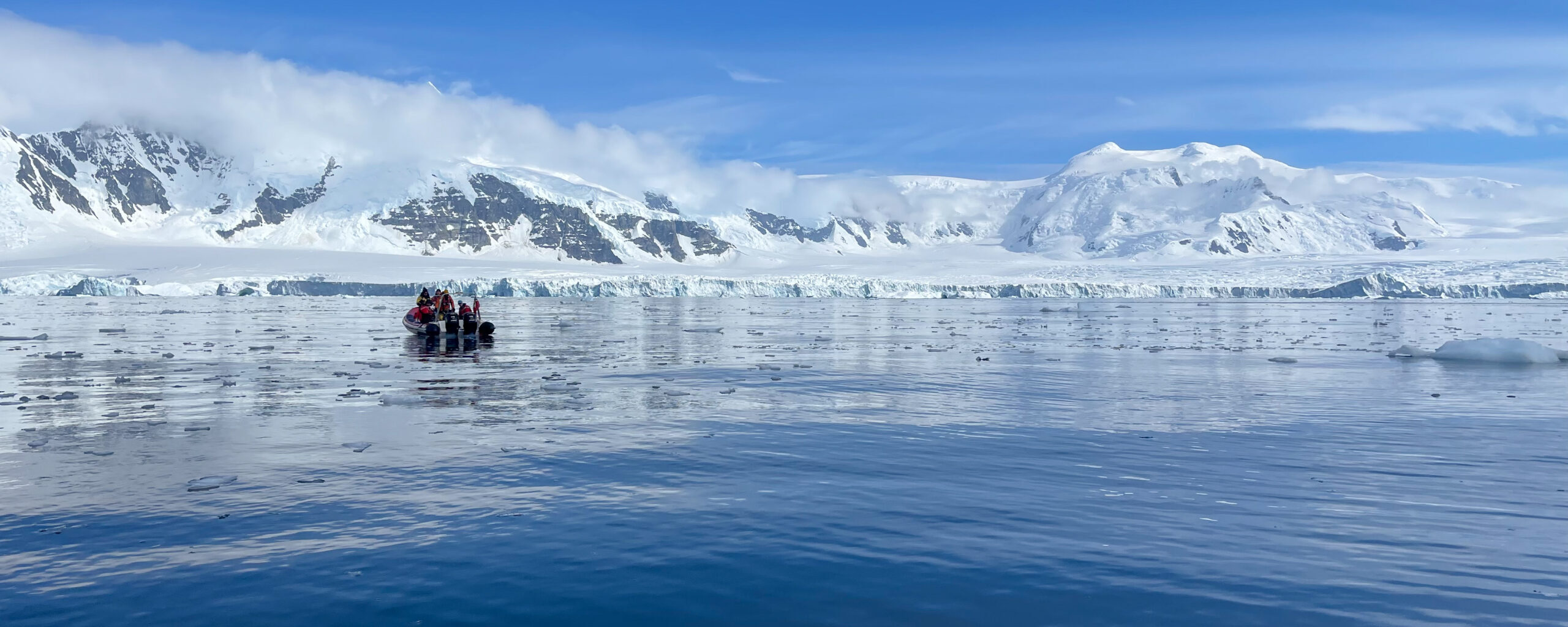
Rising temperatures caused by climate change are causing ice caps and glaciers to melt faster. The meltwater released causes sea levels to rise, 1 posing a threat to low-lying coastal areas such as the Netherlands. Ice caps and glaciers that flow into the sea melt faster because the seawater is also getting warmer. A few interesting processes contribute to this. A dive into oceanography.
Loes Gerringa, editor: Rutger Schilpzand
The ocean is not a homogeneous body of water
The ocean consists of layers of varying density. A stable ocean has light, i.e. less dense, water at the top and heavy, denser water at the bottom. Density is determined by two factors: temperature and salinity. Warm water is lighter and therefore found mainly in the upper layer, whilst water with a high salinity is heavy and thus found mainly in the lower layers. The ocean is mainly heated from above by the sun, and to a lesser extent from below by geothermal heat. The salinity of the open ocean is fairly constant, at 34.5 g/kg. However, near the coast, salinity varies due to the inflow of fresh river water and groundwater. In polar regions, fresh meltwater is added to this. The less salty water ‘floats’ on top of the saltier water.
The open ocean has a surface layer heated by the sun, and therefore light, beneath which lie layers of higher density. These layers are stable in terms of density. The layers can only be mixed by turbulence, caused, for example, by a storm. This turbulence is essential for life in the ocean. Algae, the basis of the marine food web, live at the top of the ocean where sunlight penetrates, which they need for photosynthesis. In doing so, they consume nutrients such as nitrogen and phosphorus. Turbulence causes mixing, bringing fresh nutrients from deeper waters to the surface.
Turbulence not only ensures the distribution of nutrients, but also of temperature and salinity. Thanks to this mechanism, the deep sea is not a stagnant pool of cold, salty water. In the deep sea, wind has no influence. The main source of turbulence here is the breaking of internal waves. Hans van Haren, a researcher at NIOZ and an expert in the field of internal waves, explains what these are.
Internal waves
Hans van Haren: “Internal waves, just like ‘ordinary’ waves on the water’s surface, are movements between layers of different density. For ordinary waves, these are movements between air and water; for internal waves, they are movements between layers of water of different density, meaning they differ in temperature and/or salinity. These waves are mainly caused by tides and storms. Ordinary waves have a maximum height of 10 metres; internal waves vary from 10 metres in coastal areas to as much as 200 metres in the deep sea. In themselves, waves do not mix the water. The interface between the layers of different densities moves, but does not break.
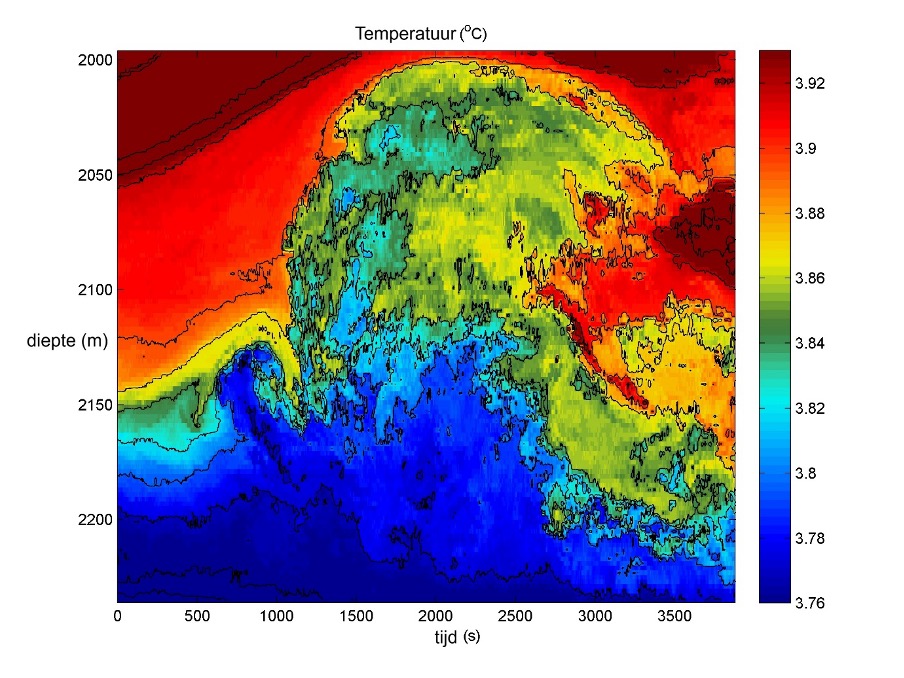
Only when internal waves break (similar to the breaking of ordinary waves on the beach) do they cause turbulence and mix the water. Internal waves break mainly on underwater obstacles, such as mountains, hills and reefs, and also on the coast. For the deep sea, this is the main source of turbulence.”
Accelerated melting in Antarctica
Antarctica is the coldest place on Earth, with an average temperature of -50°C. For the ocean, this means that the cold comes from above, unlike in the rest of the world. As a result, the upper layer of the ocean is colder than the underlying layers. Here, salinity is the variable that determines the stratification. The cold water remains at the surface and does not sink, because meltwater lowers the salinity. Temporarily in summer, in places where there is no ice, this upper layer can become even lighter and more stable when heated by the sun.
One of the factors contributing to the increasingly rapid melting of the ice in Antarctica is the upwelling of relatively warm water from deeper layers. This is a well-known phenomenon in the Amundsen Sea. This sea lies to the west of the shallow Drake Passage. Because the current around Antarctica flows eastwards, the water here must compress both horizontally and vertically in order to flow through. 3 As a result, relatively warm water is forced upwards and laps at the base of the glaciers. 4 This is a natural process, but one that is being intensified by climate change. 5
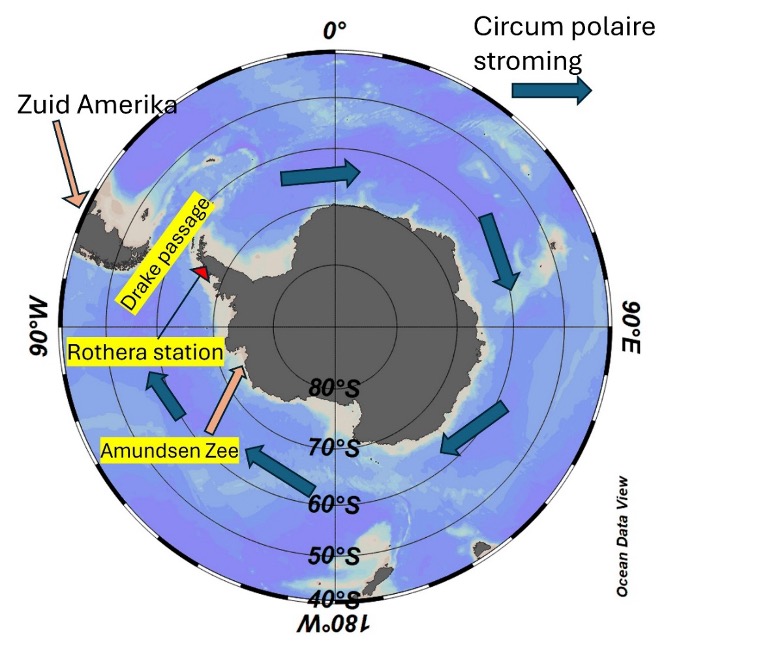
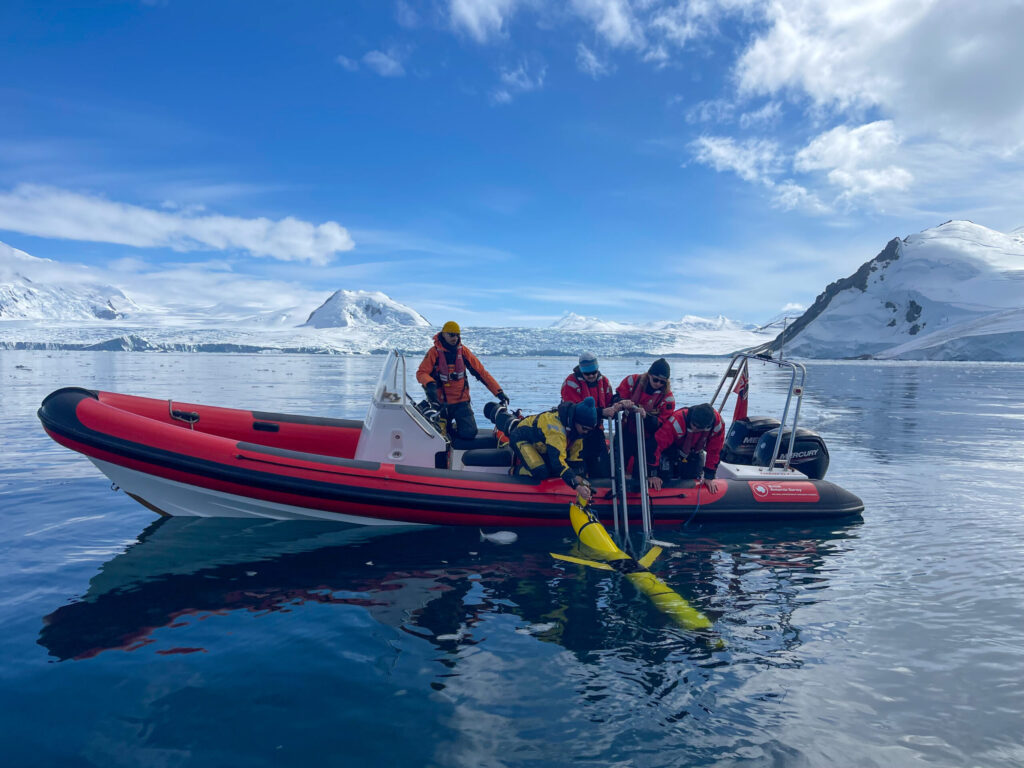
A second process causing accelerated melting due to sea-water temperature is local mixing with the underlying warmer water caused by the calving of icebergs. This is therefore a positive feedback loop: melting causes even more melting. 7 This was observed following significant calving near Rothera Research Station, a British base on the Antarctic Peninsula, closer to Drake Passage than the Amundsen Sea. Using the sonar of a research vessel, British scientists observed large internal waves forming.
According to Hans van Haren, the internal waves generated in this way will only create turbulence when they break. This will only happen in a bay, when they run up against the coast or an underwater hill, not when they run out into the open ocean.
The enormous waves observed by the British researchers are therefore likely to create a positive feedback loop, particularly at a local level.
- https://klimaatwiki.org/index.php/Gevolgen_voor_de_oceanen[↩]
- van Haren, H., et al. 2017. Prefrontal bore mixing, Geophys. Res. Lett., 44,9408–9415, doi:10.1002/2017GL074384[↩]
- Jacobs, S.S., et al. 1996. Antarctic ice sheet melting in the Southeast Pacific. Geophys. Res. Lett. 23 (9), 957–960. https://researchportal.northumbria.ac.uk/ws/files/26432416/Antarctic_Ice_Sheet_melting_in_the_southeast_Pacific.pdf. Assmann, K.M., et al. 2013. Variability of circumpolar deep water transport onto the Amundsen Sea continental shelf through a shelf break trough. J. Geophys. Res. Oceans 118 (12), 6603–6620[↩]
- Rignot, E., et al. 2008. Recent Antarctic ice mass loss from radar interferometry and regional climate modelling. Nat. Geosci. 1 (2), 106–110. https://escholarship.org/content/qt26f4j9vv/qt26f4j9vv.pdf[↩]
- Mankoff, K.D., et al. 2012. The role of Pine Island Glacier ice shelf basal channels in deep-water upwelling, polynyas and ocean circulation in Pine Island Bay, Antarctica. Ann. Glaciol. 53 (60), 123–128.
Jenkins et al. 2018. West Antarctic Ice Sheet retreat in the Amundsen Sea driven by decadal oceanic variability. Nature Geoscience, vol 11, 733–738. https://doi.org/10.1038/s41561-018-0207-4. chrome-extension://efaidnbmnnnibpcajpcglclefindmkaj/https://nora.nerc.ac.uk/id/eprint/518311/1/Jenkins_et_al_Nature_Geoscience_2018%20%28002%29.pdfl[↩] - Schlitzer, R., 2020. Ocean Data View.[↩]
- https://klimaatwiki.org/index.php/Gevolgen_voor_de_cryosfeer[↩]
- https://www.bas.ac.uk/news/making-waves-researchers-set-out-to-uncover-secrets-of-antarcticas-underwater-tsunamis/[↩]