
At the end of January, De Staat van ons Klimaat (The State of Our Climate), the KNMI’s annual report on the year 2025, was published. The report confirms the continuing trend of warming that began during the Industrial Revolution in the early 19th century. The consequences are serious: extreme weather, drought and flooding, and increased mortality due to heat. The remedy is clear: the use of fossil fuels must be phased out as quickly as possible.
2025 was a very sunny year. The strong solar radiation also caused a lot of water to evaporate. There was not much rain, especially in the spring. This meant that there was much less rain than normal. In The State of Our Climate, the KNMI describes the weather in 2025 and how it fits into global climate change.
Warm year
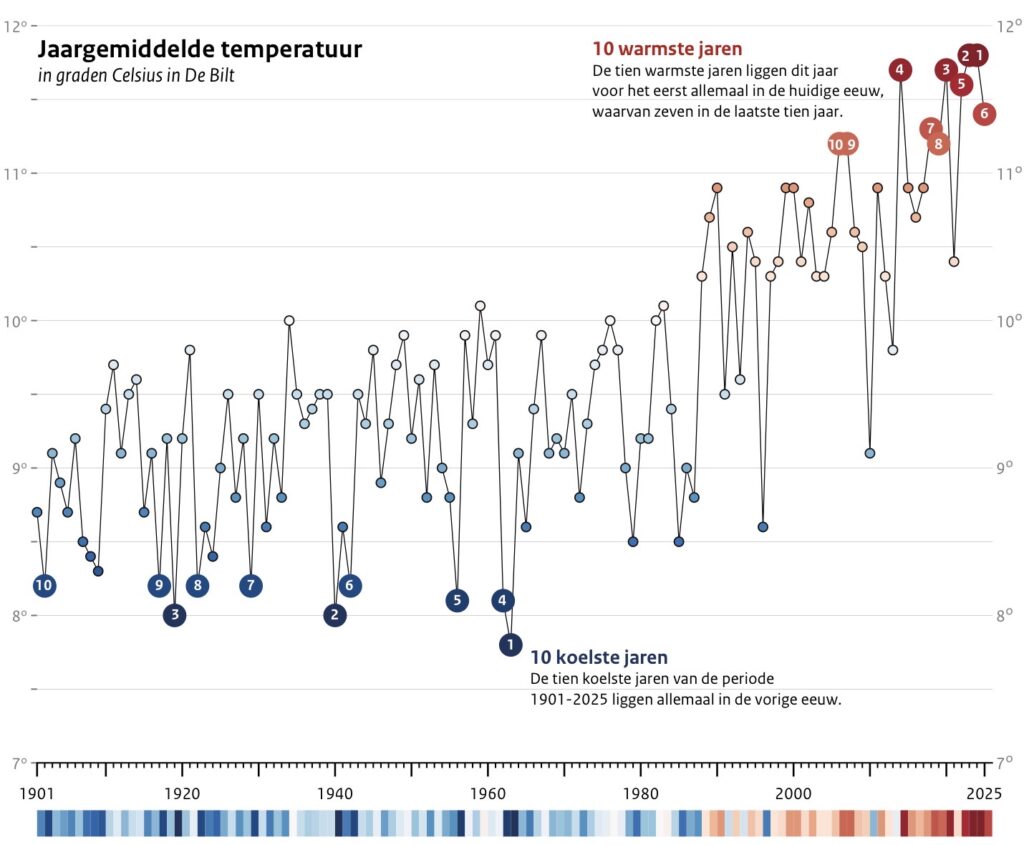
2025 was also a warm year. The average temperature in De Bilt in 2025 was 11.4 °C. This makes it the sixth warmest year since 1901, when measurements began. For the first time, the ten warmest years were all in the current century, and seven of them in the last ten years. In the first three years of this century, the Netherlands has become 1 degree warmer.
Warm summer
The summer of 2025 was the fourth warmest since measurements began, with an average temperature of 18.5 °C. This temperature is not unusual for the current climate and occurs approximately once every two years. In the cooler climate of the early 21st century and the early 20th century, this temperature only occurred once every twenty and once every thousand years.
Caribbean Netherlands
The Caribbean Netherlands is also getting warmer. For example, 2025 was the second warmest year on Bonaire, after 2024. There was also little rainfall on Bonaire, making 2025 the third consecutive year in the top ten driest years.