Revised 23 July, 2026
This is the story of how one of the most influential climate papers, the so-called “Wedges paper” 1 came into existence, thanks to the support of a company that is one of the main causes of the climate crisis and has a significant financial interest in the outcome of the technologies described in the paper. 2 It is part of a broader investigation by independent news media ProPublica and Drilled 3 4 into how the fossil fuel industry has helped to steer the global response to climate change by investing billions of dollars in research at elite universities. 5 Since the 1990s, oil companies have sponsored research centres, kept offices on campuses, paid scientists’ salaries and, in at least one case, 6 held veto power over what scientists could study with their money.
The impacts of these efforts are now so ingrained in our understanding of how to solve climate change that it can be hard to conceive of another way forward. Even the U.N.’s assessment of how to deal with the threat of climate change continues to pin hope on capturing and burying tremendous amounts of carbon pollution.
“It made solving climate change seem possible, even simple. It claimed that the world didn’t have to wait for innovation because it had the tools to start work immediately.”
The ProPublica article by Maddie Stone, Amy Westervelt and Katie Worth is thoroughly-researched with references to emails and other correspondence of the authors of the Wedges paper with BP-executives. 7
The “Wedges” article
In 2004, researchers Robert Socolow and Stephen Pacala of Princeton University published a paper in Science that would go on to become one of the most influential articles on climate change. The article, entitled “Stabilisation Wedges: Solving the Climate Problem for the Next 50 Years with Current Technologies”, 8 struck an optimistic note. It argued that we can tackle climate change using the technology we already have. There was no need to keep waiting for new ideas to emerge or to completely transform the global economy. The idea spread like wildfire and was cited more than 3,000 times. It featured in Al Gore’s Oscar-winning documentary An Inconvenient Truth, was used in UN reports on climate change, was taught at universities across the country, and was even turned into a board game.
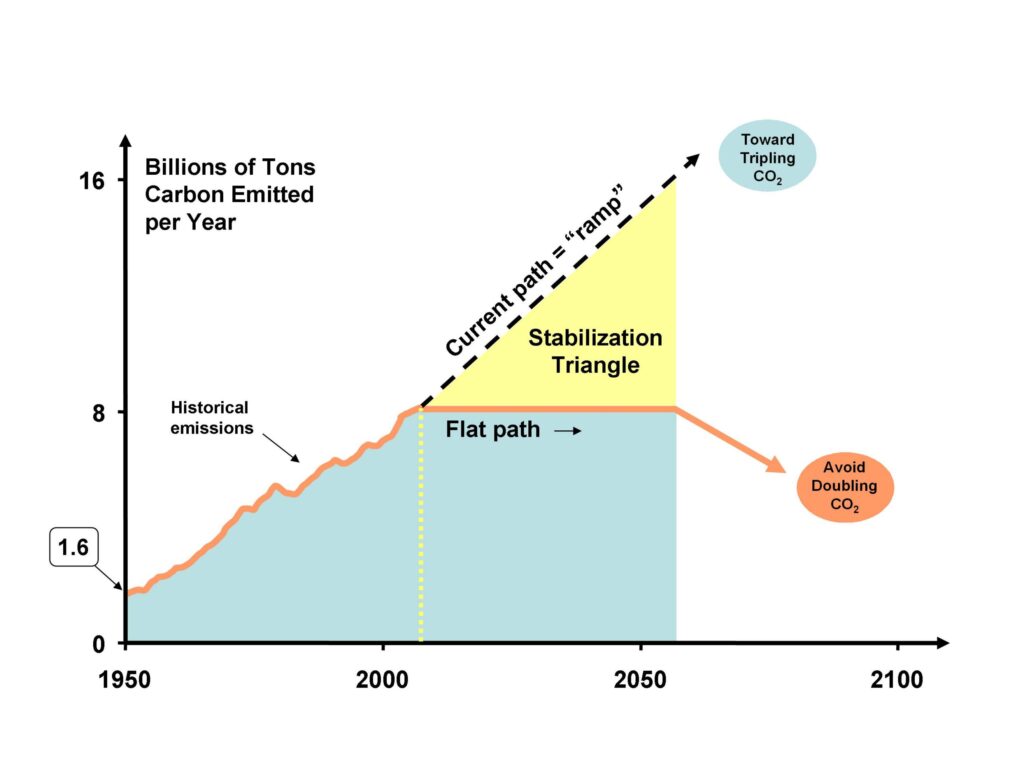
Socolow and Pacala introduced the concept of climate stabilisation wedges to decribe possible scenarios to mitigate climate change. They presented different types of interventions to decrease CO2 emissions. When they are put on top of each other, wedges form a “stabilisation triangle”. This triangle shows the estimated amount of carbon that needs to be removed from the atmosphere to stop atmospheric carbon from rising to dangerous concentrations. This framework is used to organise information about how to reduce carbon emissions. It is used to present this information to policymakers and the public. The goal is to encourage technological change and policy actions.
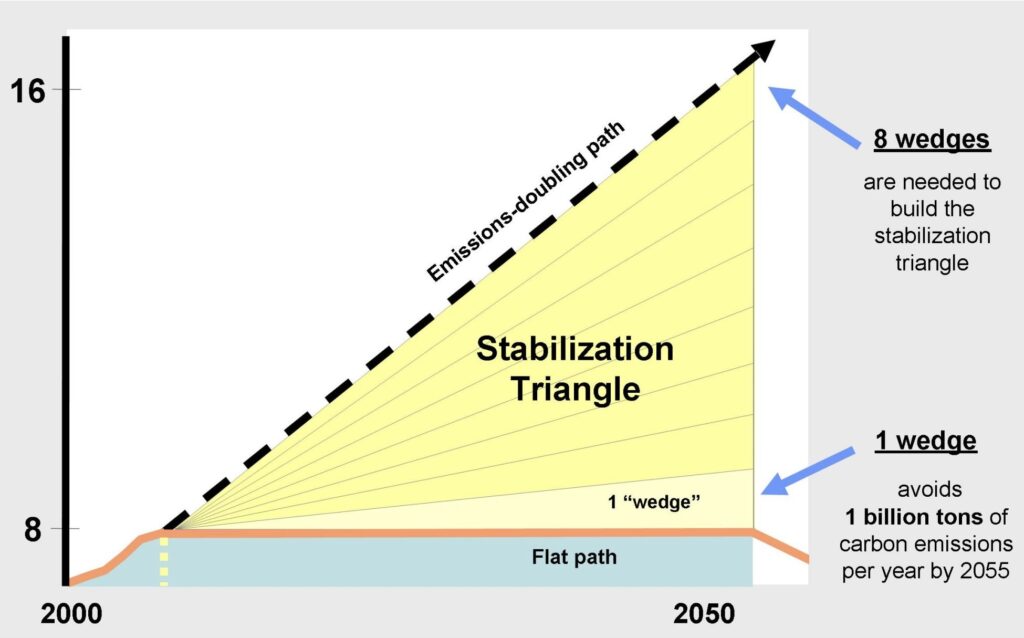
In the Pacala-Socolow wedges approach, each of the seven proposed strategies—when deployed and expanded over five decades—would avert one billion tonnes of annual carbon emissions by 2054. Together, these seven wedges would keep global emissions flat at 2004 levels, capping atmospheric CO₂ concentrations below twice pre-industrial levels. At that time, climate policy emphasised concentration stabilisation rather than temperature goals or net-zero commitments. 10
Their paper explained:
“Wedges can be achieved from energy efficiency, from the decarbonization of the supply of electricity and fuels (by means of fuel shifting, carbon capture and storage, nuclear energy, and renewable energy), and from biological storage in forests and agricultural soils. [W]e discuss 15 different examples of options that are already deployed at an industrial scale and that could be scaled up further to produce at least one wedge.”
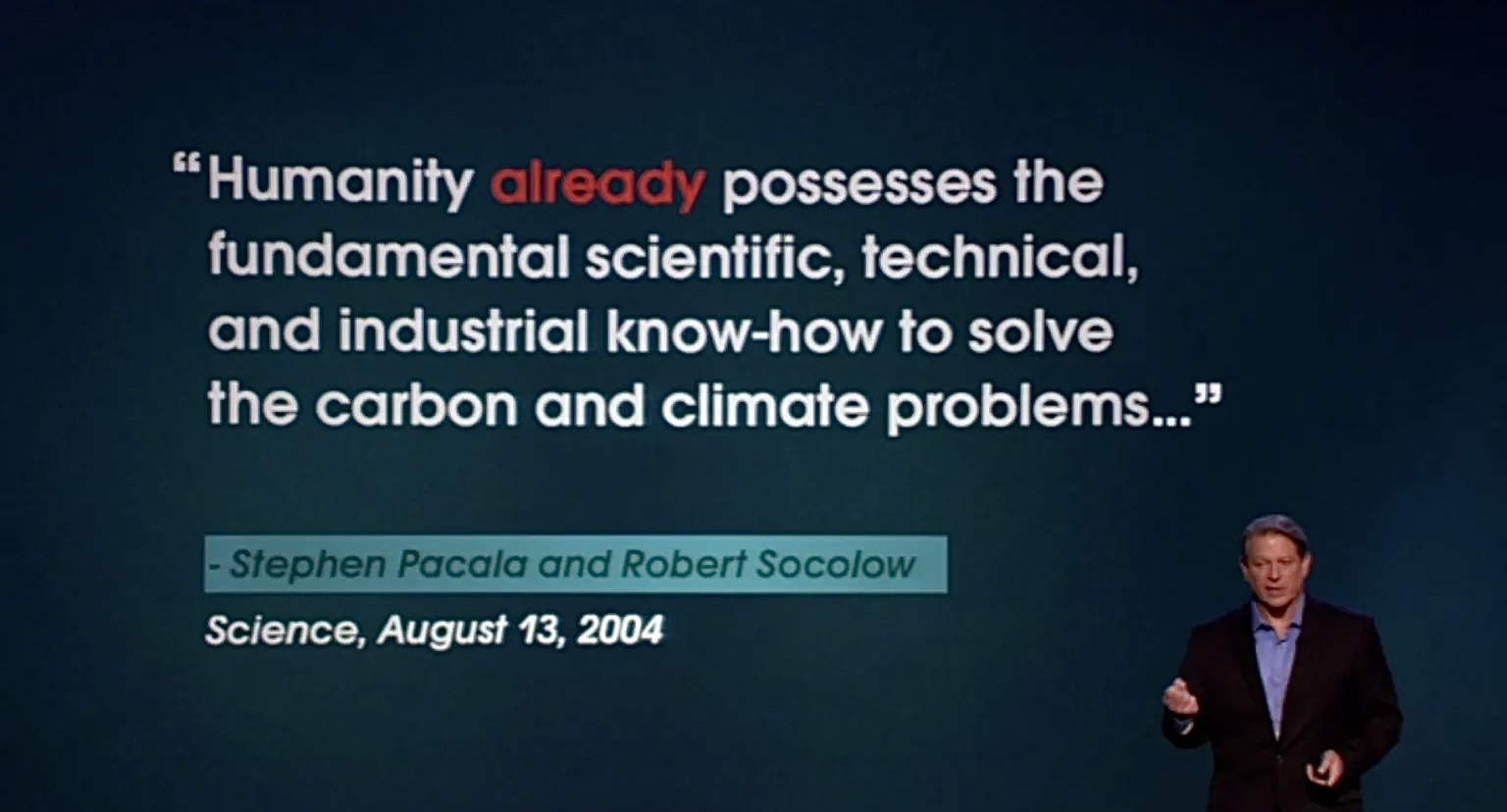
The authors held the optimistic view that technologies such as carbon capture and storage (CCS) were technically and economically viable and could indeed be be scaled sufficiently and in time to save the climate. “Humanity already possesses the fundamental scientific, technical, and industrial know-how to solve the carbon and climate problem for the next half-century.” 11
The hand of the fossil industry
What most readers did not realise was that this groundbreaking article had been heavily influenced by BP, the British oil giant — one of the companies most responsible for causing the climate crisis. Research by ProPublica and Drilled 12 revealed that BP executives reviewed several draft versions, suggested editorial changes and worked closely with the authors throughout the writing process. This raises some very serious questions about academic independence, the influence of companies on science, and whether fossil fuel interests may have shaped the global response to the climate crisis for an entire generation.
In the late 1990s, fossil fuel companies led by BP changed their communication policy in response to climate change. In 1997, BP CEO John Browne broke from the oil industry’s pattern of climate denial by publicly acknowledging climate change during a speech at Stanford University. While BP withdrew from the Global Climate Coalition and rebranded itself as “Beyond Petroleum,” the company simultaneously pursued a strategy of shaping climate science to align with continued fossil fuel consumption. Rather than calling for a drastic reduction in oil consumption, Browne emphasised efficiency improvements and carbon capture technology.
This approach reflected broader industry efforts. By 1998, the American Petroleum Institute had established a communications plan to cultivate relationships with scientists supporting positions favorable to the industry. In 1999, BP’s chief scientist Bernie Bulkin began identifying academic research programmes aligned with carbon capture and storage (CCS), a technology that theoretically could enable continued fossil fuel use while burying CO₂ emissions underground.
Bulkin selected Princeton University for a major partnership, impressed by professor Robert Socolow’s synthesis of energy challenges without demanding abandonment of fossil fuels. In June 2000, BP committed approximately $15 million over ten years to establish the Carbon Mitigation Initiative (CMI), with Ford Motor Company contributing an additional $5 million. While the contract ostensibly protected academic independence, internal documents indicated the initiative was designed as “a place of influence” to help shape government research priorities. At the kickoff meeting at the Princeton president’s mansion, BP officials actively collaborated with scientists on directing research focus—revealing a partnership far more integrated than typical academic sponsorships.
One example: (Stone et al., 2026).
That fall, [2003] Pacala traveled to London to present the framework directly to Browne. During the meeting at BP’s Westminster headquarters, Browne suggested calling the “slices” “wedges” instead. “We’re like, ‘Yeah, whatever you want,'” Pacala recalls thinking. “‘You’re paying the bills, buddy.'”
The arrangement exemplified how oil companies sought to position carbon capture technology as a bridge allowing fossil fuel interests to remain central to climate solutions.
Here are just a few examples of the intensity of the collaboration between the authors of the Wedges article and the British oil company BP. (Note: Browne is BP CEO John Browne and Chris Mottershead is BP climate adviser.)
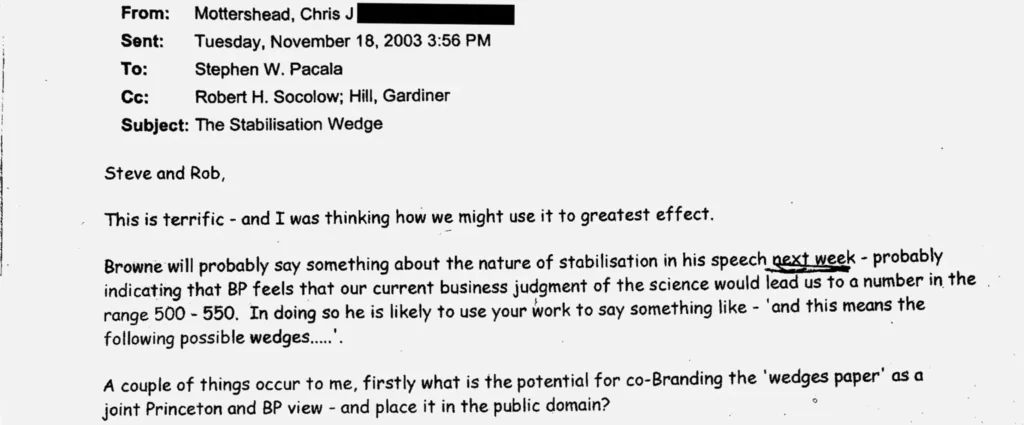
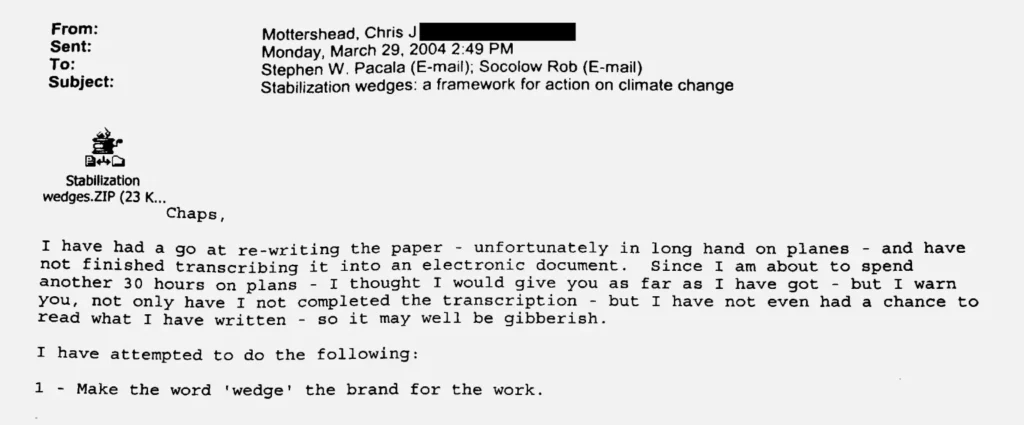
Maddie Stone and her co-investigators uncovered a draft which showed BP’s attempts to cast doubt on the legitimacy of basic climate science, describing that science as “provisional” and adding that “great uncertainties remain.” These did not make it to the final version. It would probably have made it unacceptable for publication in Science. Yet, elsewhere the paper shows the clear fingerprint of BP, notably in the term “Wedges” that was suggested by Browne himself.
Pacala admitted that there are always risks when you’re close to industry, but said that BP’s staff couldn’t control the results. Instead, the researchers thought they were helping BP to prepare for climate change, which Pacala said was a good thing. 13
This level of coordination is highly unusual for a major scientific paper on climate change. Benjamin Franta, a professor of climate litigation at Oxford University, said the relationship “flies in the face of the idea of academic independence”. His Princeton colleague, Michael Oppenheimer, agreed that Mottershead’s persistent feedback on scientific ideas “goes over the line” and is “unacceptable”.
Initiatives like these are a key component of the broader strategy to promote the acceptance of fossil fuels as a vital component of the energy transition. In Europe, fossil fuels companies have many stakes in transition policies.
Oil extraction is declared to be sustainable
An article in Forbes reports: “The [EU] Council’s Sustainable Finance Disclosure Regulation (SFDR) revision drops the exclusion that kept fossil fuel expansion out of Europe’s transition funds. The decision landed in the middle of the continent’s most severe heatwave on record.” 14 In other words, expansion of oil production is eligible for sustainability funds.
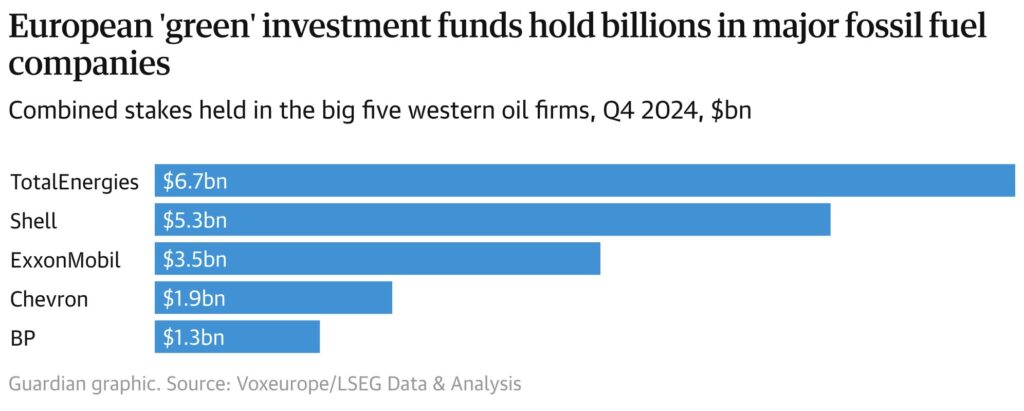
An article in The Guardian in 2025 15 revealed that European “green” investment funds hold $33bn of investments in major oil and gas companies. In a comment Richard Heede at the Climate Accountability Institute said: 16
“It is diabolical for banks and asset managers to invest billions in major fossil fuel companies under the rubric of ‘green investing’ when we need to accelerate investments in non- and low-carbon energy, in carbon efficiency, and in carbon removal technologies.”
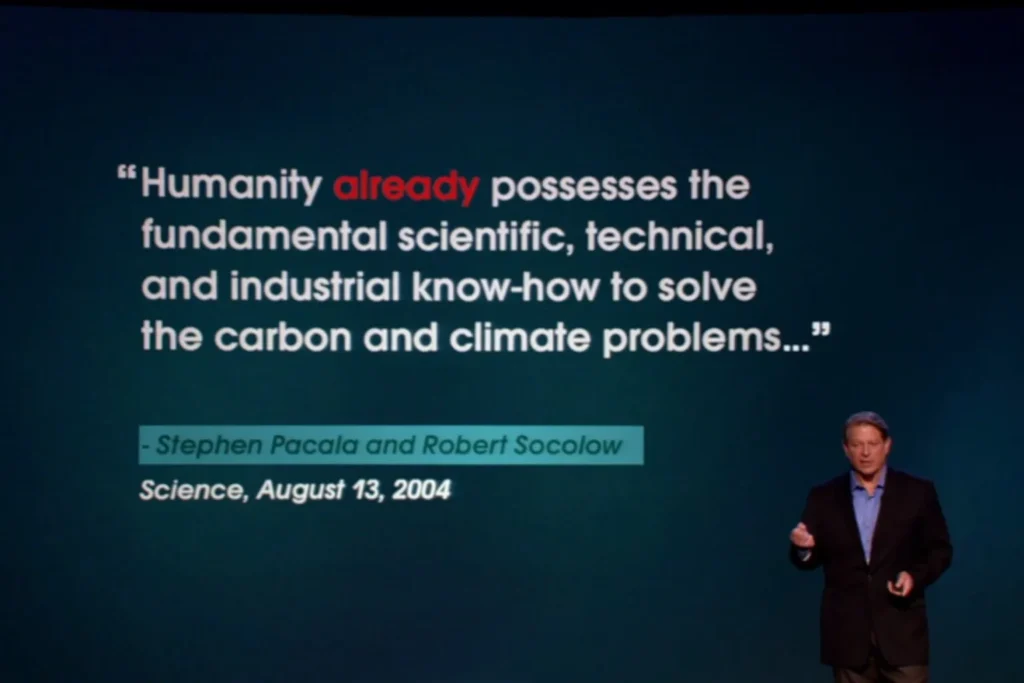
““Wedges” fast became part of the zeitgeist,” write Stone et al. Al Gore ended his film ‘An Inconvenient Truth’ in an optimistic note. “Americans need not despair, he said, because “we already know everything we need to know to effectively address this problem.” Behind him as he spoke, the opening words of Socolow and Pacala’s paper — the same ones Mottershead had suggested moving to the top — appeared on a screen.”
“In 2006, Pacala and Socolow wrote a popular article about it for Scientific American. BP, in lockstep, took out a full-page ad. In 2007, Princeton released a “Wedges” game online, which Pacala built a prototype for from planks of wood in his garage. High school students, business leaders and policymakers played it. University professors folded Princeton’s climate plan into their lessons across the country. Geoffrey Supran, a climate disinformation expert at the University of Miami, says that the paper was “mandatory reading” when he was a grad student at MIT.”
Scientific Criticism and Consequences
While the Wedges paper was very influential, notably with policymakers worldwide, it has been criticised from the start by their scientific peers.
Early criticism of Pacala and Socolow’s 2004 Stabilization Wedges paper focused on several key limitations:
- Over-optimism on scalability: Critics argued the paper underestimated the physical, economic, and political challenges of scaling technologies like nuclear power and carbon capture to the required levels within 50 years.
- Coal reliance: The framework was criticised for including “wedges” that relied on switching from coal to gas or capturing coal emissions, which critics felt locked in fossil fuel infrastructure rather than promoting a full transition to renewables.
- Cost and feasibility: Economists and engineers noted that the paper treated diverse technologies as equivalent “wedges” without fully accounting for their vastly different costs, deployment rates, and social acceptance issues (particularly for nuclear).
- Static baseline: Some argued the “business-as-usual” baseline used to calculate the wedges was flawed, potentially overstating the ease of stabilisation compared to more dynamic economic models.
Climate scientist Ken Caldeira, New York University physics professor Marty Hoffert and others wrote in a 2013 critique, Rethinking wedges: 17
“An unfortunate consequence of the “Wedges” paper was to make the solution seem easy.”
They explicitly criticized Pacala and Socolow in “Rethinking Wedges,” writing that the paper “gave us a way to believe that the energy-carbon-climate problem was manageable.” Hoffert noted that while “you have to give people hope,” convincing them they can solve climate change without eliminating fossil fuels means “you’re gonna be driving the car over a cliff.” He concluded that BP “got their money’s worth.”
Two years before “Wedges,” Caldeira and Hoffert published research in Science concluding that a “radical restructuring of the global energy system” was needed, describing “severe deficiencies” in existing technologies.
Despite these critiques, the paper was widely praised for simplifying the climate problem into manageable units and demonstrating that solutions technically existed.
The Wedges paper stated that we already had all the technology we needed to solve the climate problem well into the 21st century. We didn’t back then and we still don’t today.
Ultimately, the Wedges paper failed to reach the obvious conclusion that climate change can only be stopped by moving away from fossil fuels and from a growth-based economy.
Further reading
The SR Klimaatwiki has a full wiki page, Wondermiddelen (miracle cures), dedicated to climate change solutions that are widely promoted but, on closer inspection, are little more than illusory. One such solution is carbon capture and storage (CCS), which features prominently in the Wedges paper but, to date, has only been able to remove a tiny fraction of carbon dioxide from the atmosphere at considerable cost.
- Pacala, S., & Socolow, R. (2004). Stabilization Wedges: Solving the Climate Problem for the Next 50 Years with Current Technologies. Science, 305(5686), 968–972. https://doi.org/10.1126/science.1100103[↩]
- Stone, M., Westervelt, A., & Worth, K. (2026, June 25). Beyond Denial: How Oil Execs Shaped a Landmark Climate Study. https://www.propublica.org/article/wedges-climate-research-bp-fossil-fuel-princeton[↩]
- ProPublica is a nonprofit, investigative newsroom in the US that exposes corruption. They report in all 50 states and partner with local newsrooms. Their work spurs real-world impact and has received numerous awards, including nine Pulitzer Prizes.[↩]
- About Drilled https://drilled.media/about[↩]
- https://projects.propublica.org/carbon-captured/[↩]
- Note in Stone et al. (2026) https://web.archive.org/web/20220201063306/https://gcep.stanford.edu/about/projectselectionprocess.html[↩]
- Wedges — Documents underpinning the story “Beyond Denial: How Oil Execs Shaped A Landmark Climate Study,” by reporter Maddie Stone, part of an investigative series from Drilled and ProPublica called “Carbon Captured.” https://drilled.media/documents/38a8ac28-85cd-80a9-a82f-e537ecb3076f[↩]
- Pacala, S., & Socolow, R. (2004). Stabilisation Wedges: Solving the Climate Problem for the Next 50 Years with Current Technologies. Science, 305(5686), 968–972. https://doi.org/10.1126/science.1100103[↩]
- https://cmi.princeton.edu/resources/stabilization-wedges/slides-and-graphics/[↩][↩]
- https://rogerpielkejr.substack.com/p/another-pillar-of-climate-advocacy[↩]
- Pacala, S., & Socolow, R. (2004).[↩]
- Stone, M., Westervelt, A., & Worth, K. (2026, June 25). Beyond Denial: How Oil Execs Shaped a Landmark Climate Study. https://www.propublica.org/article/wedges-climate-research-bp-fossil-fuel-princeton[↩]
- Stone et al. (2026).[↩]
- Rentzhog, I. (2026). EU Council Lets Oil Expansion Qualify For Sustainable Funds. Forbes. https://www.forbes.com/sites/we-dont-have-time/2026/07/04/eu-council-lets-oil-expansion-qualify-for-sustainable-funds/[↩]
- https://www.theguardian.com/environment/2025/may/18/revealed-european-green-investments-hold-billions-in-fossil-fuel-majors[↩][↩]
- https://climateaccountability.org/carbon-majors/[↩]
- Davis, S. J., Cao, L., Caldeira, K., & Hoffert, M. I. (2013). Rethinking wedges. Environmental Research Letters, 8(1), 011001. https://doi.org/10.1088/1748-9326/8/1/011001[↩]