Gerben ter Riet1
Epidemiologists love the term ‘risk’. They try to quantify health risks. This is not easy when it comes to health risks as a result of man-made global warming.
Health itself is a difficult concept. In the past, it meant ‘absence of disease’, but later it came to refer to complete physical, mental and social well-being. Recently, the emphasis has been on resilience: the ability to cope with adversity and adapt.
And then there is the term ‘as a result of’. This means that we must be certain that we are identifying the correct cause or causes. Would we have had fewer sick or dead people or less loss of quality of life if there had been less warming, but everything else had remained exactly the same? Can we investigate this experimentally? Do we take indirect consequences into account? Suppose that during a heatwave, the cooling systems in data centres fail, as happened three years ago in London, causing power failures in healthcare institutions. Do you then count the additional victims who die as a result of inadequate care caused by those failures as a consequence of the heatwave?
Risks
Risks are strange things. It’s not just about numbers. Risks we choose ourselves often feel different from risks imposed on us by others. Think of protesters smoking strong tobacco who protest against a planned high-voltage cable over their homes because they are concerned about the risk of leukaemia. I remember my father, in 1979, strongly opposing the compulsory wearing of seat belts. After all, he wondered, how do you get out of your car if you end up in the water?
Risk is about chances. Dealing with chances. Quite difficult. Not to mention conditional chances. A psychologist convincingly demonstrated that few doctors and few judges are good at dealing with chances. And Lucia de Berk2 knew that even so-called experts can make very serious mistakes, which is why she ended up in prison for years, wrongfully convicted of serial murder.
In the climate debate, it is often even more difficult because we are asked to make value judgements about events that may take place in 20 years or more. We tend to value receiving 100 euros now or a healthy year of life now more than the prospect of 100 euros or a healthy year of life in 20 years, even after adjusting for inflation. One hundred euros in your hand now feels worth more than 100 euros in 20 years’ time. If only because you are not sure you will still be around then.
Discounting the future
Health economists, for example, count 12 months of life in full health, lived in the year 2045, as 6 healthy months of life. Where did the other six months go? Well, they deduct 20 times 3.5% of the duration; each year in the future is discounted by 3.5%.
Should climate economists be allowed to do this too? If you heavily discount the future, investing in robust climate policy today quickly seems too expensive and nonsensical. But can we morally justify devaluing the lives of young people living today and those of future generations? Devaluing the future is saying: our pleasure now is much more important than their suffering later. That those who are not yet born cannot have a say in this is ‘too bad’ for them.
Recently, the Dutch seemed to think the climate crisis was not that important at all. All attention was focused on a small proportion of the large group of people who visit our country for more than six months at a time, also known as migrants.
But what do we see in this figure from this year’s AXA Future Risks Report?3 Over a period of six years, some 20,000 different people from 18 countries chose their personal top five out of 25 things to worry about.
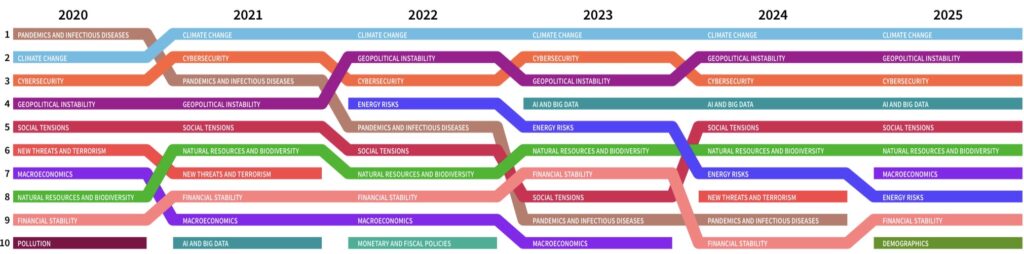
The light blue line at the top shows that after 2020, climate change ranks fifth on the list of concerns. This year too. Are politicians taking their citizens’ concerns seriously enough?
Hot air
Years ago, when my daughter Simone, now 21, asked me to write something in her friendship book, I wrote the words ‘hot air’ under the heading ‘I hate’. She asked me what hot air was. You know what it is, and my hatred for it remains undiminished.
So, politicians and administrators, stop selling hot air and implement strong climate policies. Ban the sale of hot air by major polluters. Our carbon budget is running out very quickly and we are heading for temperature rises that we really do not want. I am not even talking about the other eight dimensions of planetary health, such as pollution from fertilisers and PFAS and the serious impoverishment of our nature, deforestation and ocean acidification. Now, let’s take a look at what these graphs tell us.
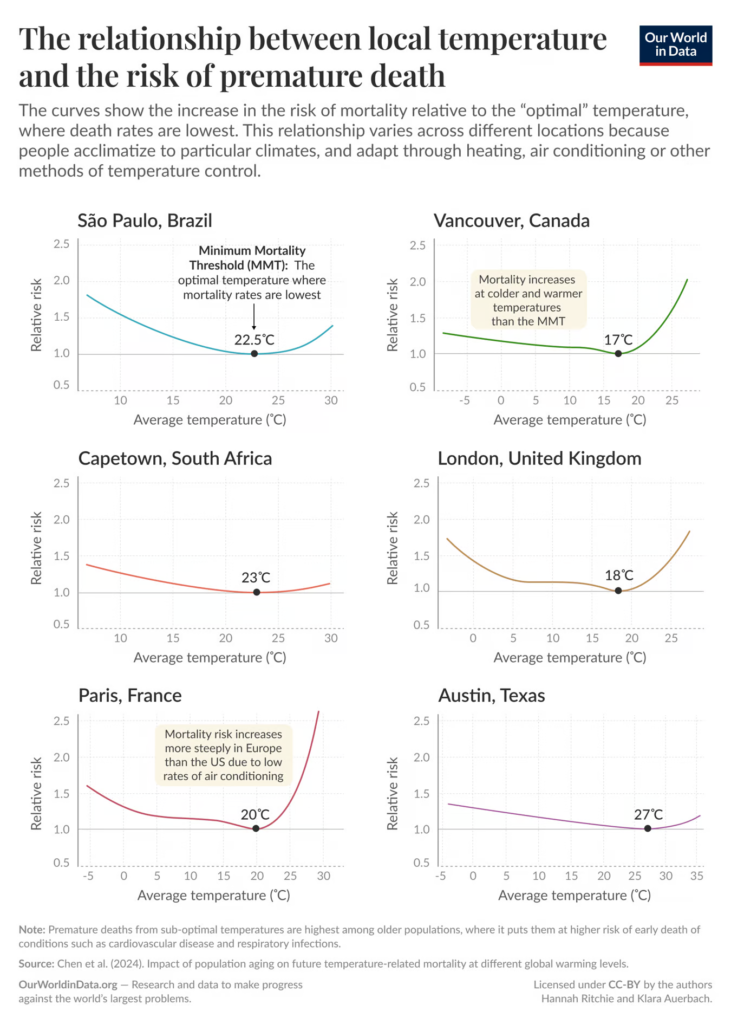
In this image from the Climate Wiki, we see that, based on six major cities, the temperature at which the fewest people die can vary greatly. In London, mortality is lowest at 18 degrees, but in Austin, Texas, it is lowest at 27 degrees. On the vertical axes, we see the relative change in the probability of dying. That relative probability of dying ranges from two times smaller to two and a half times larger. We see how that probability changes with temperature in these six major cities.
What is striking is that this relationship can vary greatly from city to city. In Vancouver, people are apparently accustomed to low temperatures, but at 25 degrees Celsius, your chance of dying there is twice as high as at 17 degrees. In Paris, that chance increases even more in hot weather. In Austin, the correlation is much weaker. However, we do see that the relationship is not a flat straight line anywhere.
Bear in mind that other evidence is needed to prove that global warming causes additional deaths. That evidence does exist, but it is not shown in this graph. After all, it is theoretically possible that global warming in Paris causes the temperature there to very often be 20 degrees, the dip in the graph. It is also important to realise that these graphs do not represent natural constants. This is mainly culture, air conditioning, water points, green spaces, behavioural changes, etc. We can therefore intervene in this, although preventing further global warming remains necessary, of course.

This figure (also from the Climate Wiki) shows the number of very hot hours per year in four major regions of the world as global warming increases from 1.5 (left) to 4 degrees Celsius (right). This reflects climate injustice. At the bottom, you can see that in the US, this number of very hot hours per year only really increases at 4 degrees of global warming. But in countries around the equator, which have played hardly any role in causing global warming, you can already see the effects increasing enormously from 2 degrees of warming. And make no mistake, the latest predictions show that there is a high probability that we are heading for an average of 3 degrees of global warming.
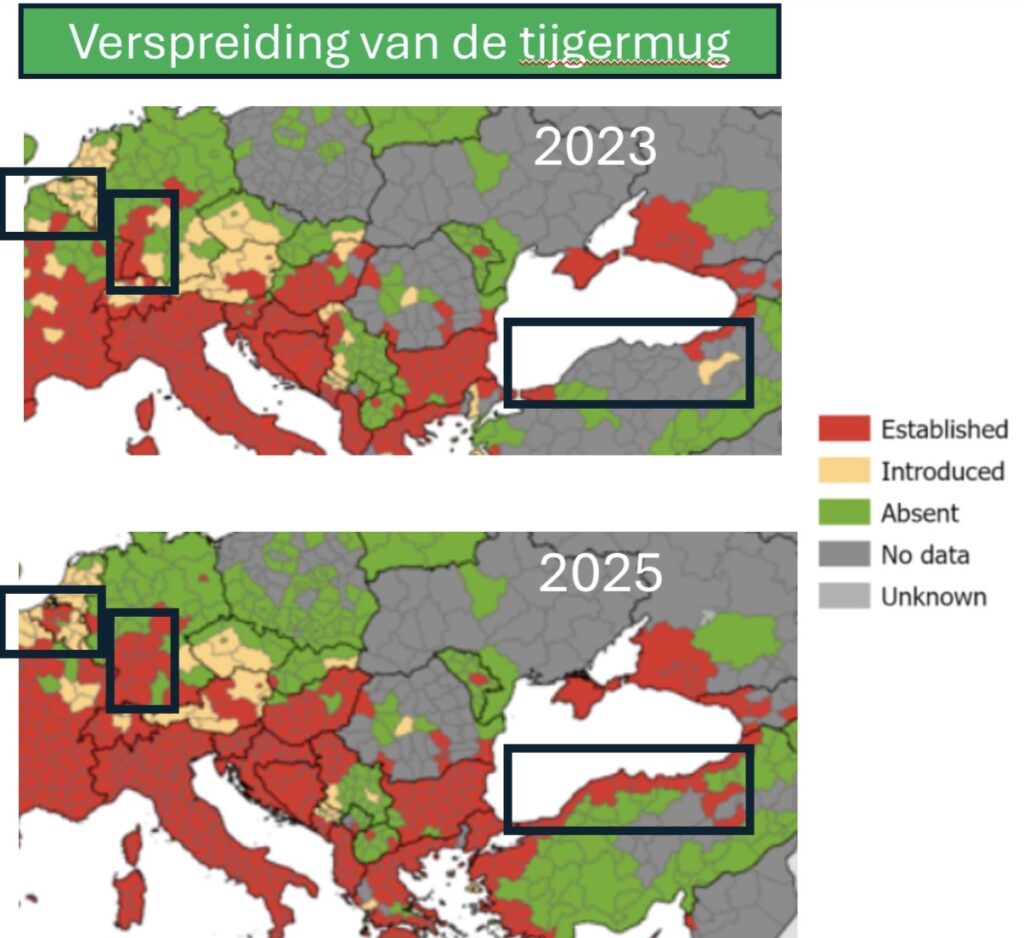
Finally, the image on the right. Here we see that in two years’ time, the distribution area of the tiger mosquito, which is capable of transmitting a large number of infectious diseases, has become much larger. You can see this by looking at the rectangles and comparing how much more red (the mosquito is firmly established) and yellow (the mosquito has gained a foothold) there is in the bottom image (2023) compared to the top image (2025). These are areas around Belgium, southern Germany and the Turkish Black Sea coast.
The number of people suffering from what used to be tropical diseases such as dengue fever and Chikungunya, as well as viral and worm diseases, is expected to increase significantly in Europe. In large parts of Italy, the aggressive biting behaviour of the mosquito is already a cause of loss of quality of life, a source of annoyance and a reason for children not to play outside. We know that the latter is itself a health risk.

Gerben ter Riet. I am a medical epidemiologist affiliated with Amsterdam UMC and Amsterdam University of Applied Sciences. I have been active in Scientist Rebellion for three years.
- Gerben gave this lecture at the celebration of 10 years of ‘Paris’ on 12 December. ↩︎
- Lucia de Berk was a paediatric nurse who was wrongfully convicted as a serial killer for the deaths of a number of children. The De Berk case is now considered a textbook example of the dangers of using statistical probability calculations in criminal proceedings. https://en.wikipedia.org/wiki/Lucia_de_Berk_case ↩︎